
Separate what you must keep from what you can cut
Put the Saturday open-house print items into must-keep and optional piles on a BaseHalf canvas. Connect the answer only to those piles, and leave a photo collage that came in the same message off the decision.
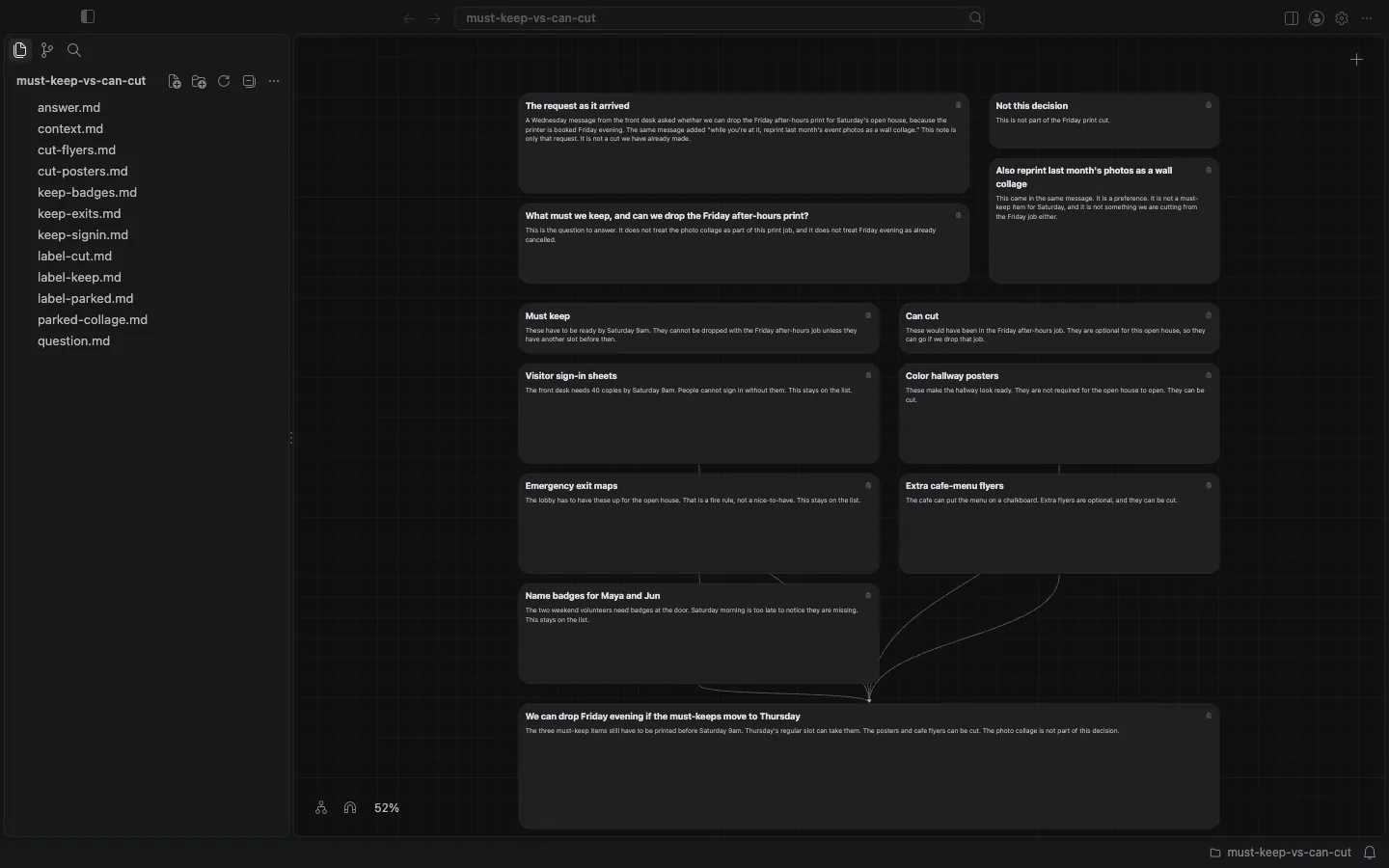
A Wednesday message from the front desk asks whether you can drop the Friday after-hours print for Saturday's open house, because the printer is booked Friday evening. In the same sentence it adds, "while you're at it, reprint last month's event photos as a wall collage." The cheap mistake is to cancel the whole Friday job, then notice Saturday morning that the sign-in sheets and the exit maps never got another slot. The cheaper work is earlier, and it is visual: put what you must keep in one pile, put what you can cut in another, leave the collage off this decision, and write the answer only after those piles are in view.
This is a different step from unpacking a fog until you can name a question, from lining up options against a checklist, from separating observations from interpretations, from sorting facts, assumptions, and open questions, from keeping a problem away from the fixes already being offered, from weighing evidence for and against, from laying out the conditions for a yes, from separating what was decided from what is still open, or from lining up the steps that have to happen before you promise a date. Here the question is already named. The risk is that everything in the message gets treated as one list: the must-keeps get dropped with the extras, or the collage gets treated as if it were part of the cut.
What must we keep, and can we drop Friday evening?
Say the front desk sent this mix on Wednesday:
These have to be ready by Saturday 9am. They cannot be dropped with the Friday after-hours job unless they have another slot before then:
- Visitor sign-in sheets. The front desk needs 40 copies. People cannot sign in without them.
- Emergency exit maps. The lobby has to have these up for the open house. That is a fire rule, not a nice-to-have.
- Name badges for Maya and Jun, the two weekend volunteers. Saturday morning is too late to notice they are missing.
These would have been in the Friday after-hours job. They are optional for this open house, so they can go if that job is dropped:
- Color hallway posters. They make the hallway look ready. They are not required for the open house to open.
- Extra cafe-menu flyers. The cafe can put the menu on a chalkboard.
And then there is one sentence that is not part of this decision:
- "While you're at it, reprint last month's event photos as a wall collage." That is a preference. It is not a must-keep item for Saturday, and it is not something you are cutting from the Friday job either.
On a BaseHalf canvas, those notes are ordinary Markdown files in one folder. The must-keep pile and the can-cut pile sit in two columns, for your eyes. The collage sits off to the side of the question, under a "Not this decision" label, so it cannot pretend to be part of the Friday cut.
A pile is not a connection, and neither is a selection
Sitting in the must-keep column does not make a note part of the answer. A connection does. In BaseHalf, a line from A to B means A is upstream of B: A's context flows into B, and the list is saved in B, in the frontmatter of a Markdown note. The answer on this board is connected to the three must-keep items and the two optional ones. Those five notes are what the answer stands on. They are why the answer allows dropping Friday evening only if the must-keeps move to Thursday's regular slot, and why the posters and flyers can be cut.
The photo collage stays off the decision, without a line. The collage may still be worth doing later. The answer does not use it, so it is not declared as its upstream.
You can still point at a slice without changing those lists. A selection is temporary. It is what "this" can refer to if you later ask an agent. It is not written into the answer, and it does not force an agent to read only those files. A request that names something else still wins.
Select the slice the answer already named
For this board, the slice is the answer and the five items it is connected to. The photo collage stays visible on the board, and it stays out of the selection.
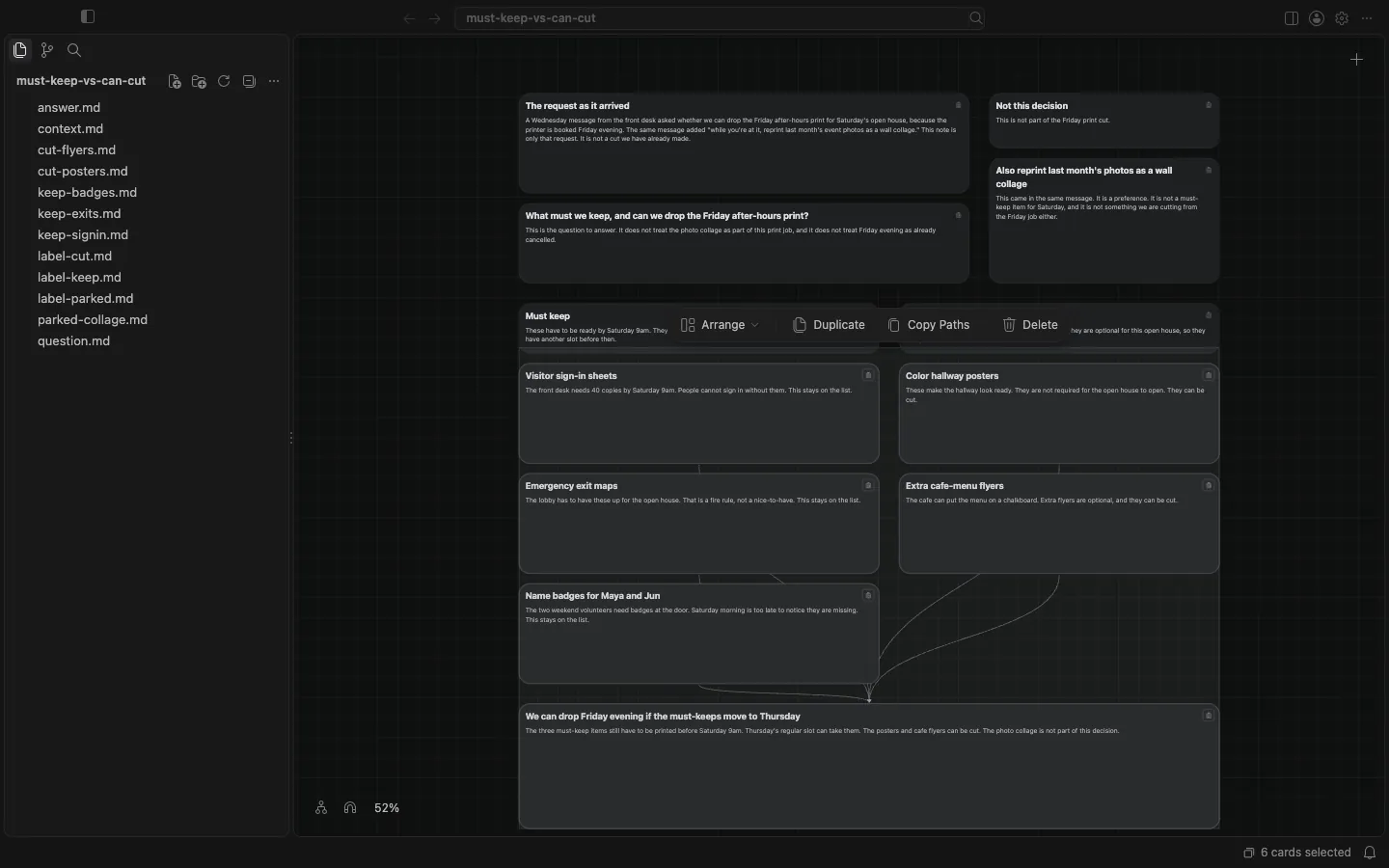
If you then ask Claude Code or Codex, ask about that slice. Not "can we cancel Friday?" Ask whether those five notes can support the cut the answer names: three must-keeps moved to Thursday, two optional items dropped, and no writing of the photo collage as if it were part of this decision.
What to keep after you answer
Keep the named question, the answer, and the upstream list that says which items it rests on. Leave the photo collage parked, so it is not mistaken for part of the Friday cut the next time someone opens the folder. When Thursday's slot is booked for the sign-in sheets, the maps, and the badges, update those cards if you need to, and only then consider rewriting the answer. Do not connect a preference just because it sat nearby.
Limits
Two tidy piles do not make the classification complete, or the names the right ones. If the exit maps were already printed on Tuesday and nobody updated that card, or if Maya's badge is a must-keep but Jun is no longer coming, you will have a tidy board that still misses the failure. The canvas makes it visible which items you treated as must-keep, which you treated as optional, and which preference you refused to bring into the cut. You still have to get the must-keeps a slot, or change the answer if that slot disappears.
Separate what you must keep from what you can cut, before you drop a job. Write upstream only for the notes that answer actually uses, including the optional items you are choosing to cut. Select that slice if you want to ask an agent about it.