
Write the check that proved the answer, not only the answer
We opened RFC 8785 in a BaseHalf folder, grew a note from the official PDF, checked object key order, the number 4.50, and spaces between tokens against the official text and a small canonicalizer, then wrote those passing checks next to the answers in the same question page.
I needed a canonical JSON string I could hash, and I kept catching myself writing down the conclusion alone. The useful part is the check that proved it, sitting in the same page, so I can reopen the folder and see why the first guess was wrong.
I put the official text of RFC 8785, JSON Canonicalization Scheme (JCS), by A. Rundgren, B. Jordan, and S. Erdtman, Independent Submission, Informational, IETF, June 2020, into a folder and opened it in BaseHalf 0.7.0. I retrieved both the PDF and the plain text from the RFC Editor on 2026-11-16, Asia/Shanghai, and kept them to read. I am not republishing the document. A short SOURCE.md records those facts, including the SHA-256 of each file. I also looked at the RFC Editor errata list the same day. Errata ID 6292 is verified and editorial: Section 3.2.2.2 cites the wrong ECMA-262 section number. Errata ID 7920 is verified and technical: it asks Section 5 to note that JSON -0 is serialized as 0. Neither item changes the object-property sorting rules in Section 3.2.3, the 4.50 example in Section 3.2.2, or the whitespace rule in Section 3.2.1 that this note checks.
I wrote question.md first, with three guesses, before I had checked the official text.
- If I start from
{"b":1,"a":2}, does JCS keep that key order? First guess: yes. JCS keeps the order I wrote. - In the canonical string, does the number
4.50stay as4.50? First guess: yes. I wrote a trailing zero, so the canonical form should keep it. - Is a space after the colon allowed, as in
{"a": 1}? First guess: yes. One space after the colon is ordinary JSON.
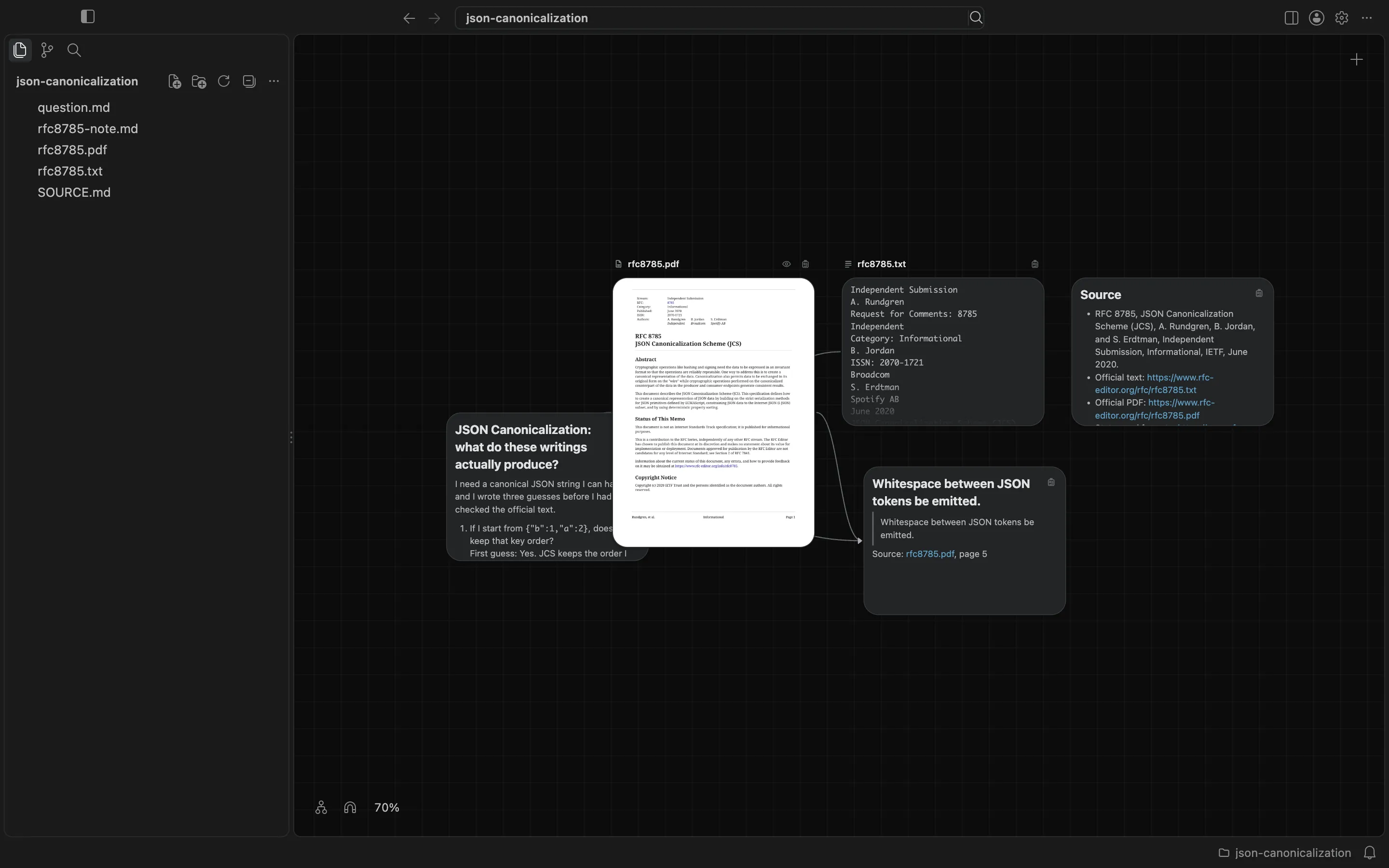
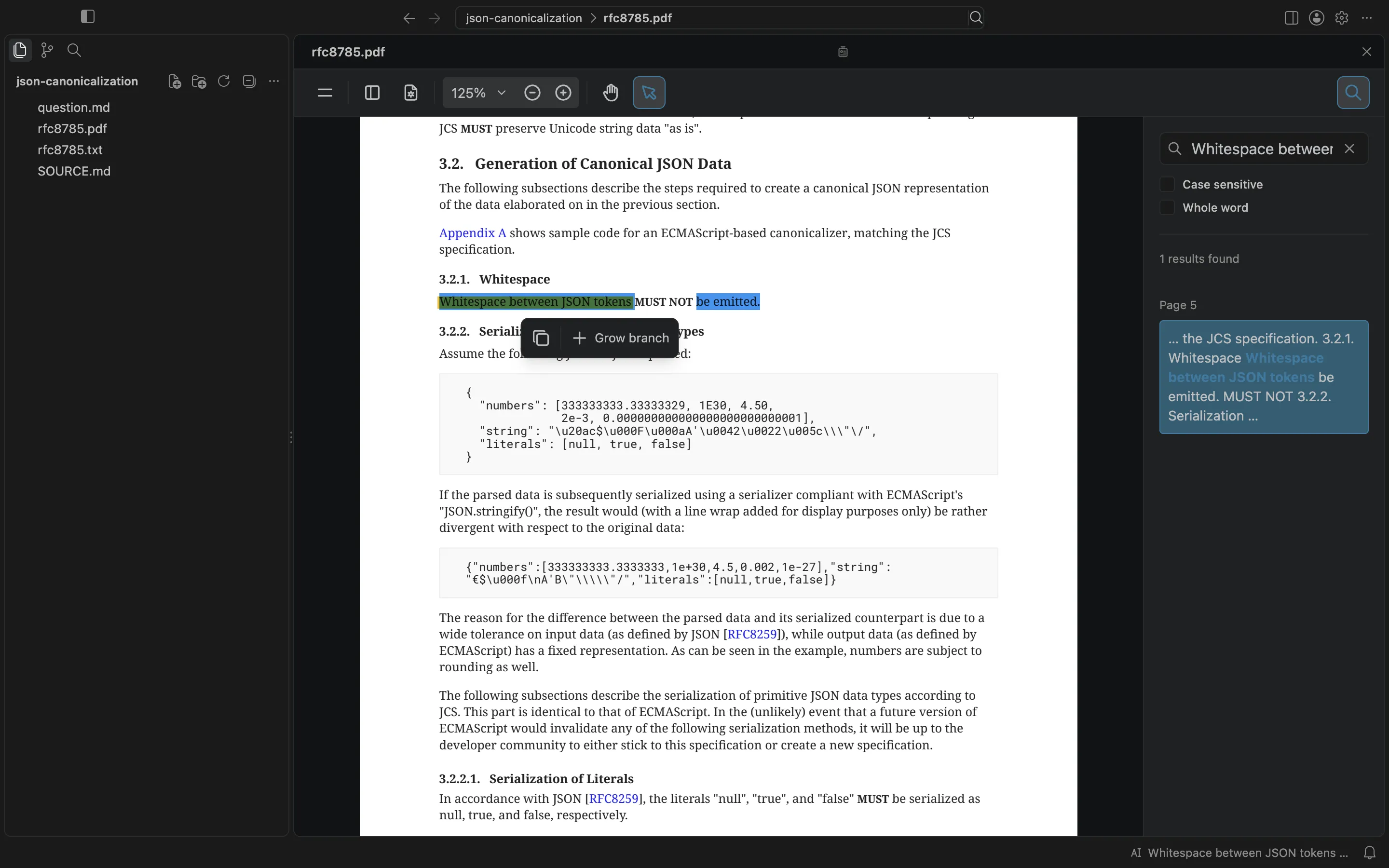
In Card Detail I opened the PDF, searched for Whitespace between, and landed on Section 3.2.1, on page 5. I selected the official sentence and used Grow branch. That created rfc8785-note.md, already listing rfc8785.pdf as its upstream, with a blockquote and a source link to page 5. The product cut the title and the quote before MUST NOT, so the note reads "Whitespace between JSON tokens be emitted." I left it as the product wrote it, and I checked the official sentence in the PDF and the text.
I connected the official texts and the grown note to question.md by writing them into its upstream list. Lines appeared on the canvas between the same files. SOURCE.md sits nearby, but I did not connect it. Being nearby is for my eyes. A connection is the context that should stick.
I selected the question card and started Claude Code in the Agent Area. The Agent Area is where the session runs; it is not itself the agent. I asked it to read question.md and only the files in its upstream, and for each of the three questions to say whether my first guess was right, give the answer, and quote the official rule with the section number, without changing any files.
It opened those files, and after 38 seconds, at 18:16 Asia/Shanghai, it said all three of my first guesses were wrong. The Checked answers section in question.md was still empty, because I had asked it not to change files.
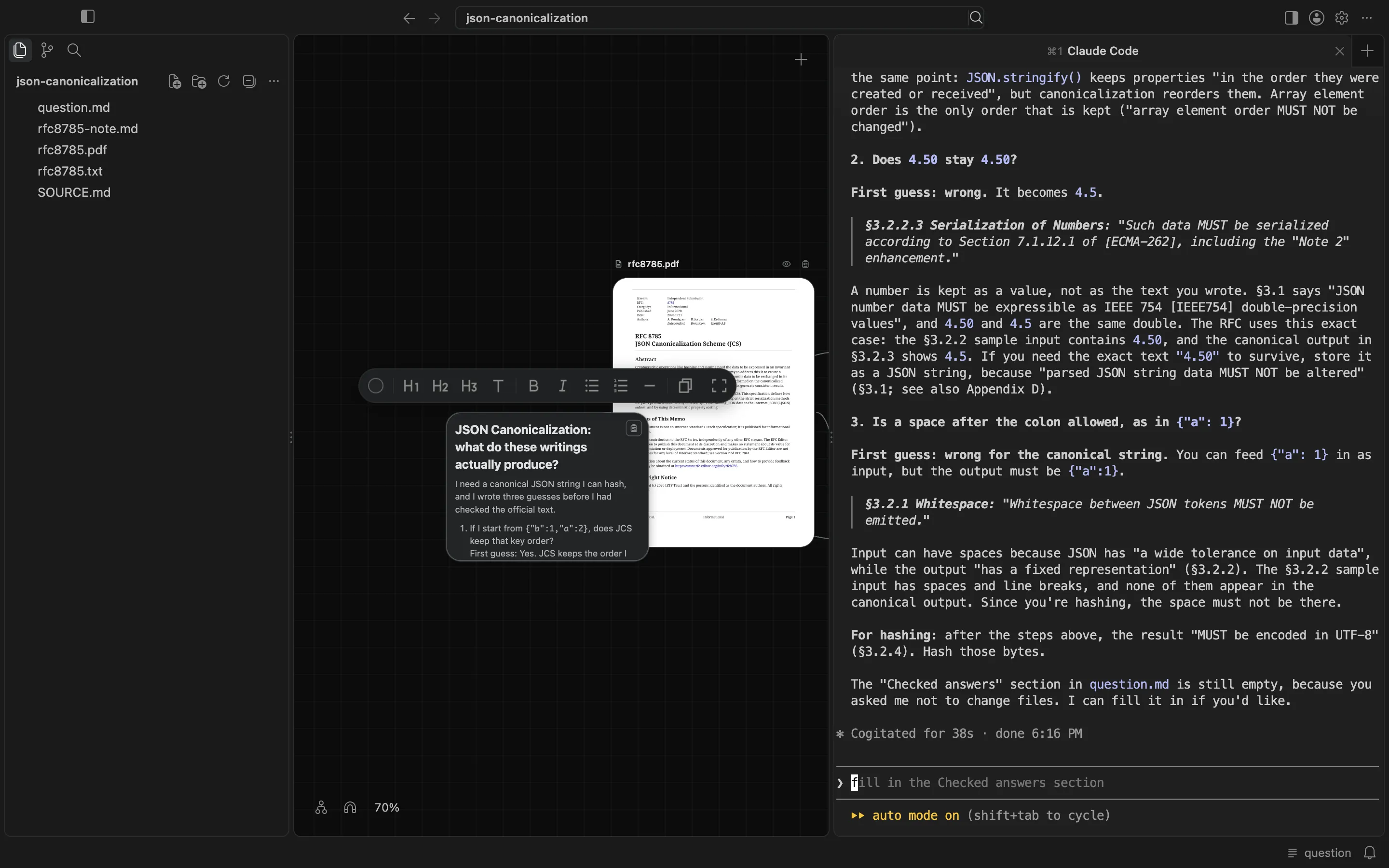
I did not stop at the model's wording. I checked the same sentences in the official text, and I ran a small canonicalizer that sorts property names as arrays of UTF-16 code units, as Section 3.2.3 requires.
- JCS does not keep the order I wrote. Section 3.2.3 says the result is not yet canonical "since JSON object properties are not in lexicographic (alphabetical) order," and: "JSON object properties MUST be sorted recursively, which means that JSON child Objects MUST have their properties sorted as well." The check is the official sample in that same section: the input object in Section 3.2.2 lists
numbersfirst, thenstring, thenliterals, and the canonical form starts{"literals":[null,true,false],"numbers":[333333333.3333333,1e+30,4.5,0.002,1e-27],"string":...}. The same canonicalizer produced{"a":2,"b":1}from{"b":1,"a":2}. It also reproduced that official sample, and it produced the official order of the Unicode property-name test in Section 3.2.3 (Carriage Return, One, Control, Latin Small Letter O With Diaeresis, Euro Sign, Emoji: Grinning Face, Hebrew Letter Dalet With Dagesh). - The number
4.50does not stay4.50in the canonical string. Section 3.2.2 shows a parsed object whosenumbersarray includes4.50, and the ECMAScript-compliant serialization is[333333333.3333333,1e+30,4.5,0.002,1e-27]. The same4.5appears in the canonical object in Section 3.2.3. Section 3.2.2.3 says JSON number data MUST be serialized according to Section 7.1.12.1 of ECMA-262, including the "Note 2" enhancement. The check is that official pair in which4.50becomes4.5, plusJSON.stringify(4.50)in this Node.js, which follows that same ECMAScript rule and returns4.5. - A space after the colon is not allowed in the canonical string. Section 3.2.1 says: "Whitespace between JSON tokens MUST NOT be emitted." The check is the official canonical form in Section 3.2.3, which has no space after
:or,, and the canonicalizer, which produced{"a":1}from the object{a:1}, not{"a": 1}. Ordinary JSON may accept a space on input. The canonical output must not emit one.
I wrote those checked answers, with the section numbers, the official sentences, and the passing checks, back into the same question.md page, under the heading I had left for them, and I left my first guesses above that heading. In Card Detail, the Preview shows the answers and the checks in the page I will reopen tomorrow. The Source view shows the upstream list at the top of the same file: rfc8785.pdf, rfc8785.txt, and rfc8785-note.md.
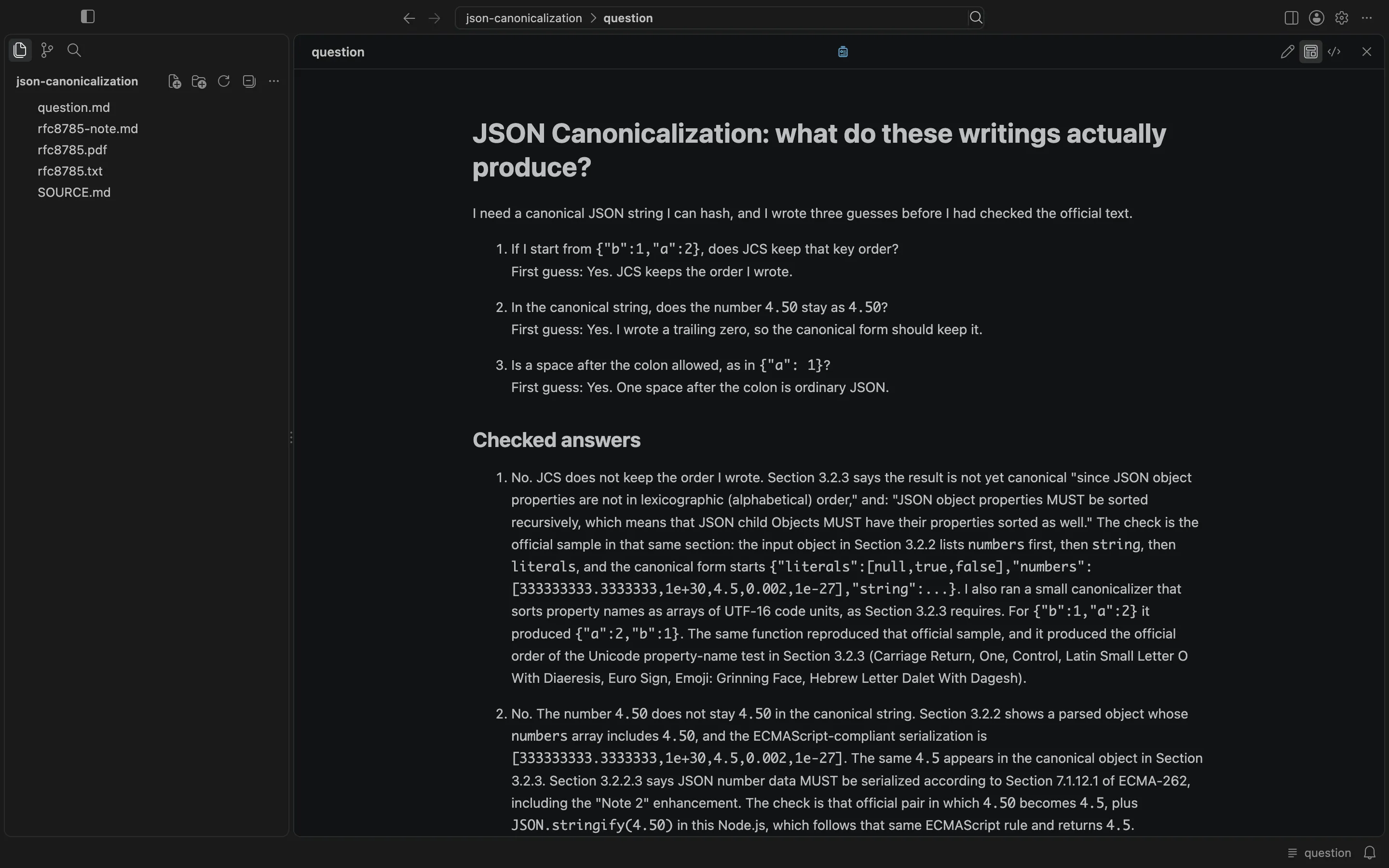
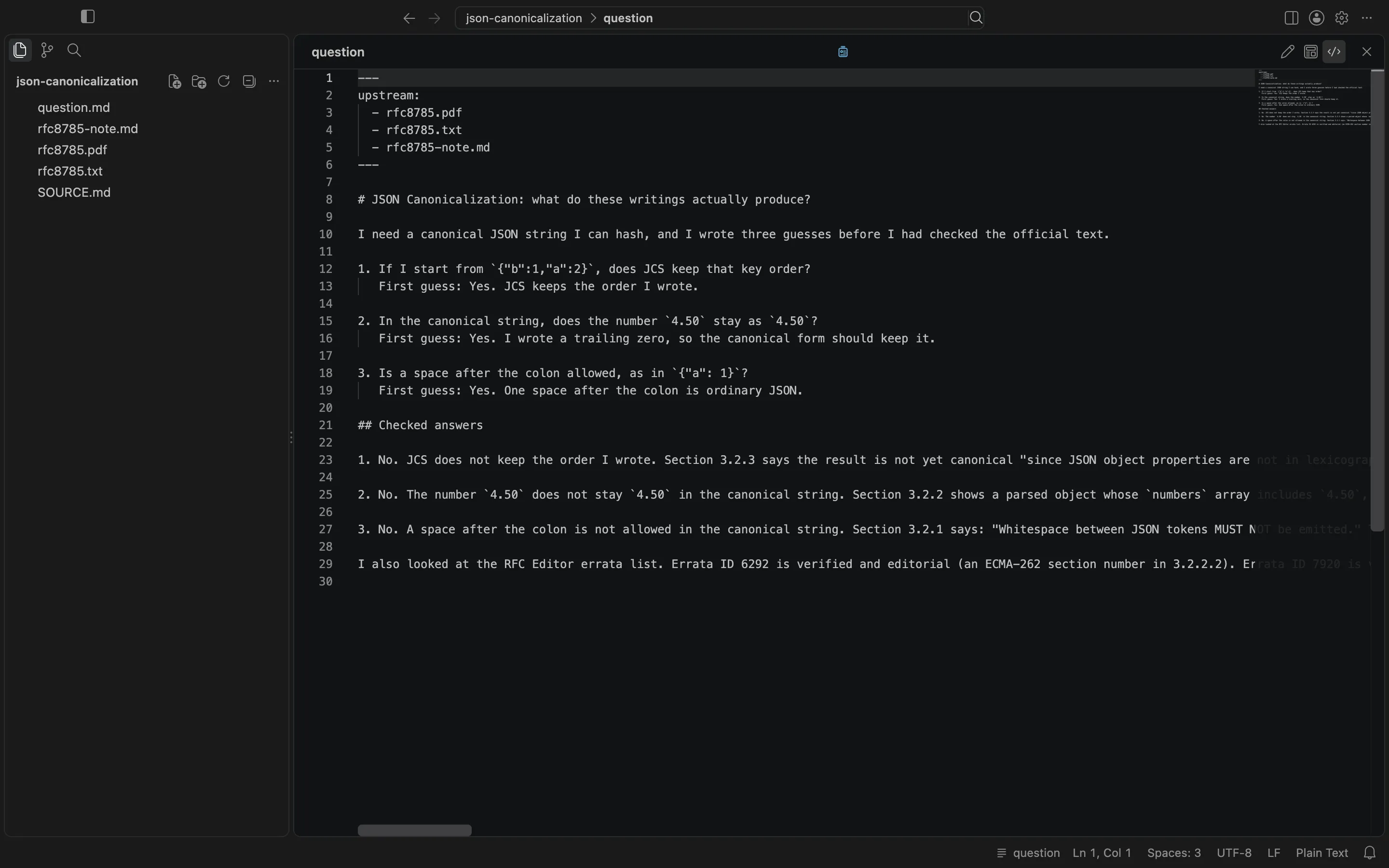
This is not a notebook that answers every file by itself, and it is not a built-in summary. The selection in the status bar lasts only while the window is open. The official text, the grown note, the question, and the checked answers with the checks that proved them are ordinary files in the folder. If I close the chat, I still have the page where the check sits next to the answer, not only the conclusion.