
Write the rejected form next to the rule
We opened RFC 9457 in a BaseHalf folder, grew a note from the official PDF, checked an omitted type, a generator status mismatch, and an about:blank title, then wrote the rejected forms next to the official rules in the same question page.
I keep writing HTTP API error bodies that look like problem details, then finding out a field I left out or filled in "more precisely" is not what the rule allows. I wanted the rejected form sitting next to the official sentence, not only in a chat I would close.
I put the official text of RFC 9457, Problem Details for HTTP APIs, by M. Nottingham, E. Wilde, and S. Dalal, IETF, July 2023, into a folder and opened it in BaseHalf 0.7.0. The document obsoletes RFC 7807. I retrieved both the PDF and the plain text from the RFC Editor on 2026-11-15, Asia/Shanghai, and kept them to read. I am not republishing the document. A short SOURCE.md records those facts, including the SHA-256 of each file. I also looked at the RFC Editor errata list the same day. Errata ID 7731 is held for document update and concerns additionalProperties in the Appendix A schema example. Errata ID 8858 is reported, not verified, and concerns the Appendix A schema title still saying "RFC 7807". Neither item changes the type, status, or about:blank rules in Sections 3.1.1, 3.1.2, and 4.2.1 that this note checks.
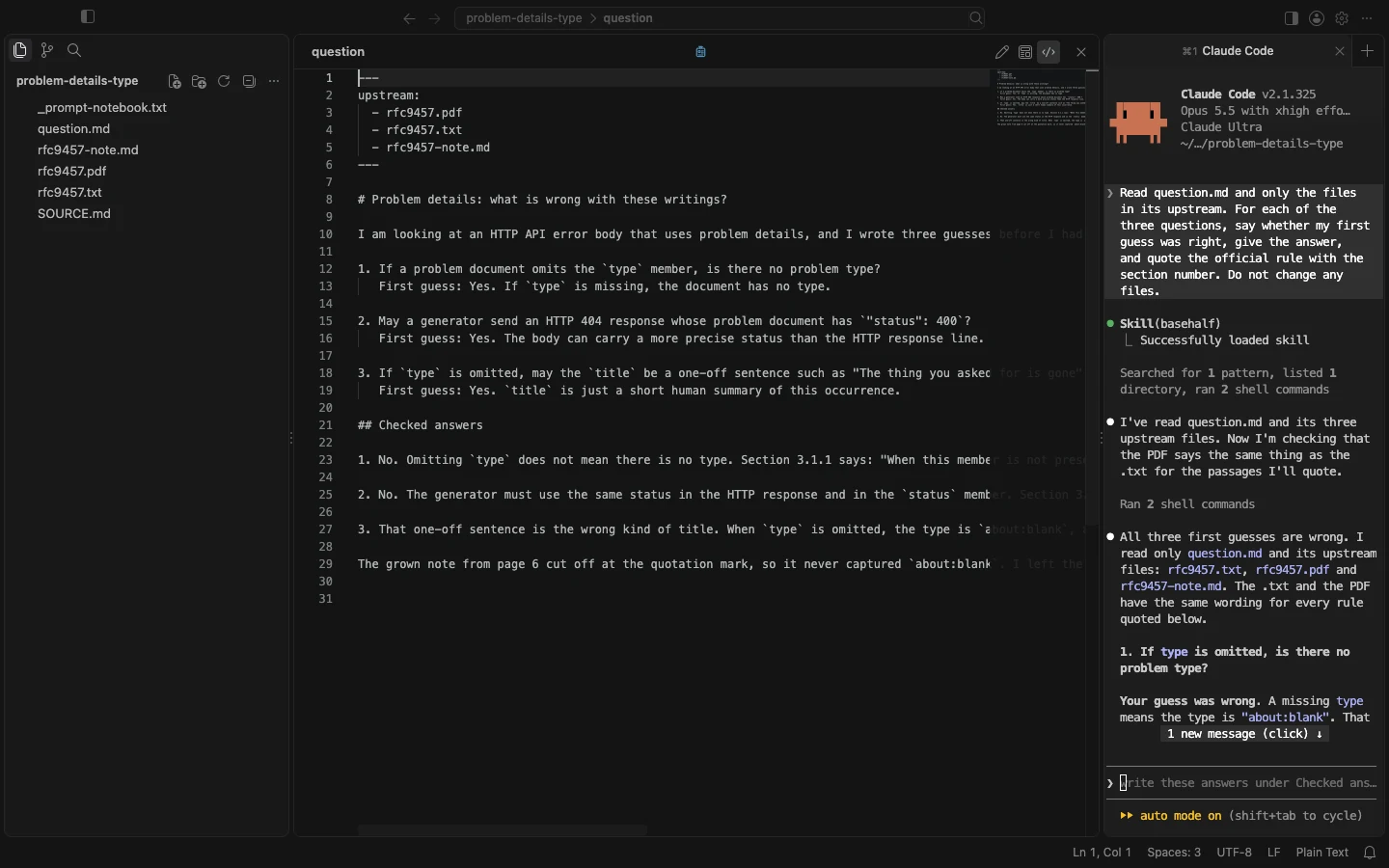
I wrote question.md first, with three guesses, before I had checked the official text.
- If a problem document omits the
typemember, is there no problem type? First guess: yes. Iftypeis missing, the document has no type. - May a generator send an HTTP 404 response whose problem document has
"status": 400? First guess: yes. The body can carry a more precise status than the HTTP response line. - If
typeis omitted, may thetitlebe a one-off sentence such as "The thing you asked for is gone" for a 404? First guess: yes.titleis just a short human summary of this occurrence.
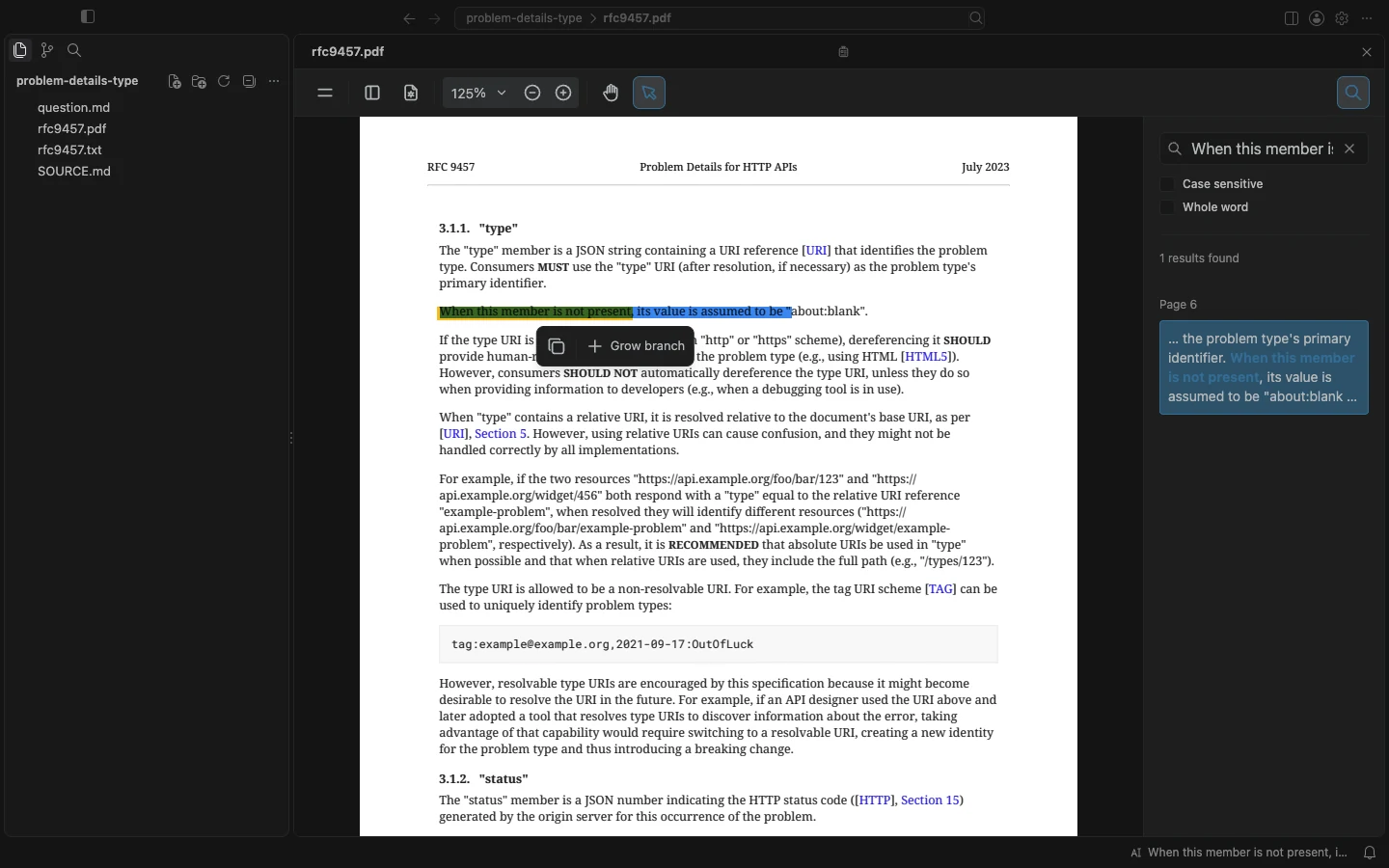
In Card Detail I opened the PDF, searched for When this member is not present, and landed on Section 3.1.1, on page 6. I selected the sentence that begins there, and used Grow branch. That created rfc9457-note.md, already listing rfc9457.pdf as its upstream, with a blockquote and a source link to page 6. The product cut the title and the quote at the quotation mark, so the note never captured about:blank. I left it as the product wrote it.
I connected the official texts and the grown note to question.md by writing them into its upstream list. Lines appeared on the canvas between the same files. SOURCE.md sits nearby, but I did not connect it. Being nearby is for my eyes. A connection is the context that should stick.
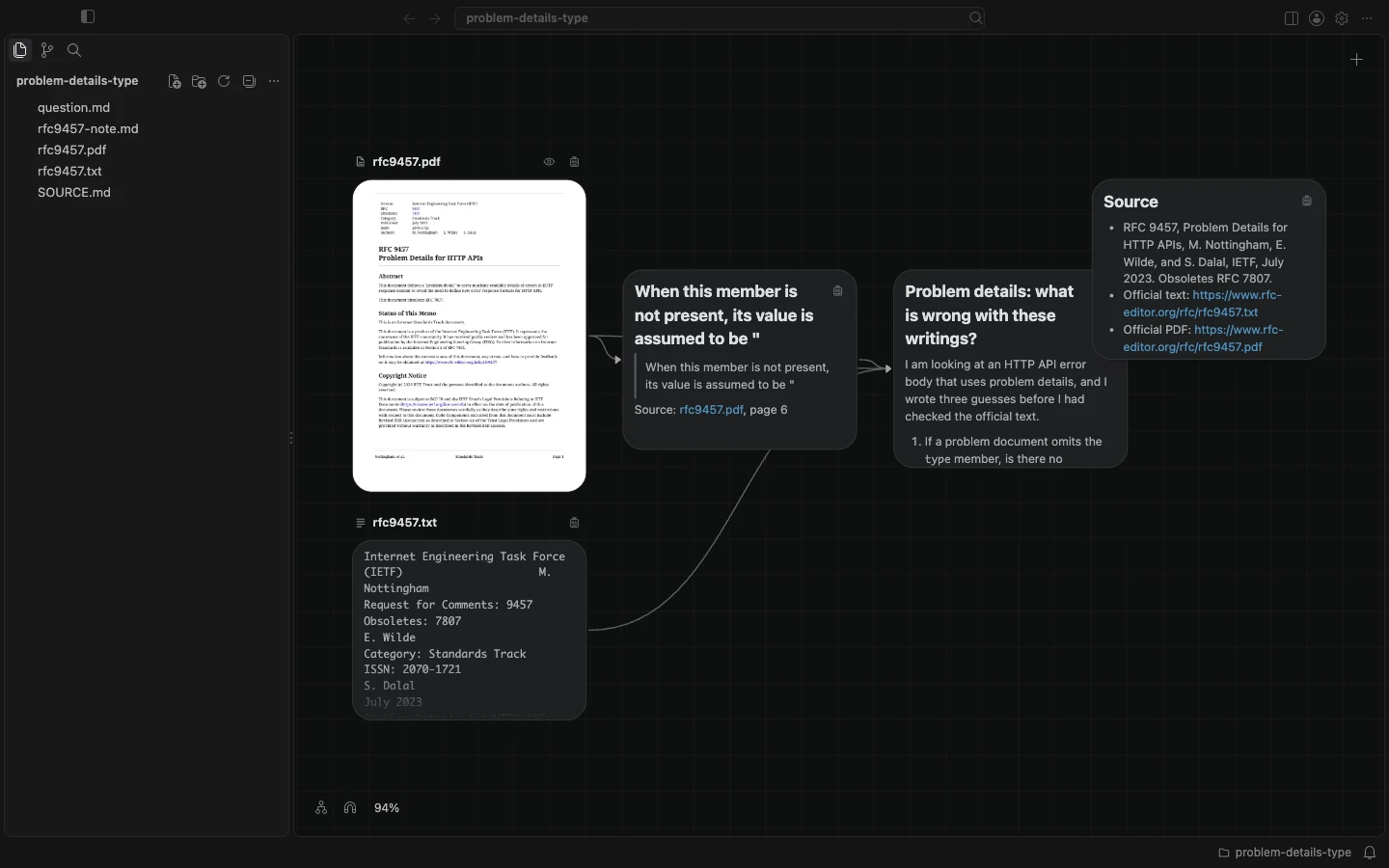
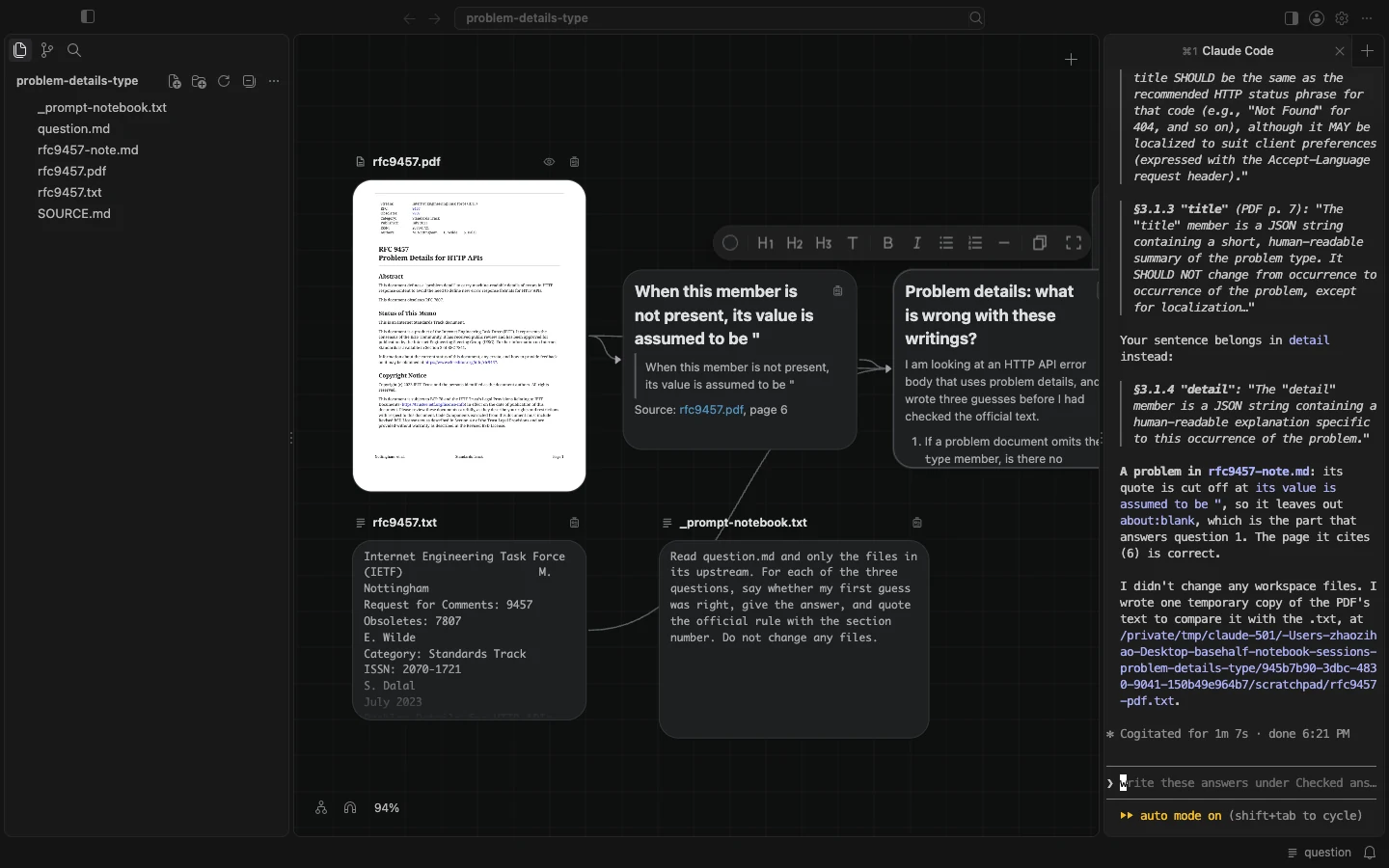
I selected the question card and started Claude Code in the Agent Area. The Agent Area is where the session runs; it is not itself the agent. I asked it to read question.md and only the files in its upstream, and for each of the three questions to say whether my first guess was right, give the answer, and quote the official rule with the section number, without changing any files.
It opened those files, and after 1 minute and 7 seconds, at 18:21 Asia/Shanghai, it said all three of my first guesses were wrong. Claude Code was v2.1.325, Opus 5.5, with xhigh effort, on Claude Ultra.
I did not stop at the model's wording. I checked the same sentences in the official text.
- Omitting
typedoes not mean there is no type. Section 3.1.1 says: "When this member is not present, its value is assumed to be "about:blank"." Section 4.2.1 adds that any problem details object without an explicittypemember implicitly uses that URI, and thatabout:blankmeans the problem has no additional semantics beyond the HTTP status code. - The generator must use the same status in the HTTP response and in the
statusmember. Section 3.1.2 says the member is only advisory for the consumer, and: "Generators MUST use the same status code in the actual HTTP response, to assure that generic HTTP software that does not understand this format still behaves correctly." A rejected form is an HTTP 404 whose body has"status": 400. Section 5 notes the two can disagree if an intermediary changes the HTTP status in transit. That describes a fault on the way; it does not give the generator permission to send a mismatch. - The one-off sentence is the wrong kind of title. When
typeis omitted, the type isabout:blank, and Section 4.2.1 says the title SHOULD be the recommended HTTP status phrase for that code, such as "Not Found" for 404, although it MAY be localized. Section 3.1.3 saystitleis a short summary of the problem type and SHOULD NOT change from occurrence to occurrence, except for localization. The sentence belongs indetail(Section 3.1.4), which is the explanation specific to this occurrence.
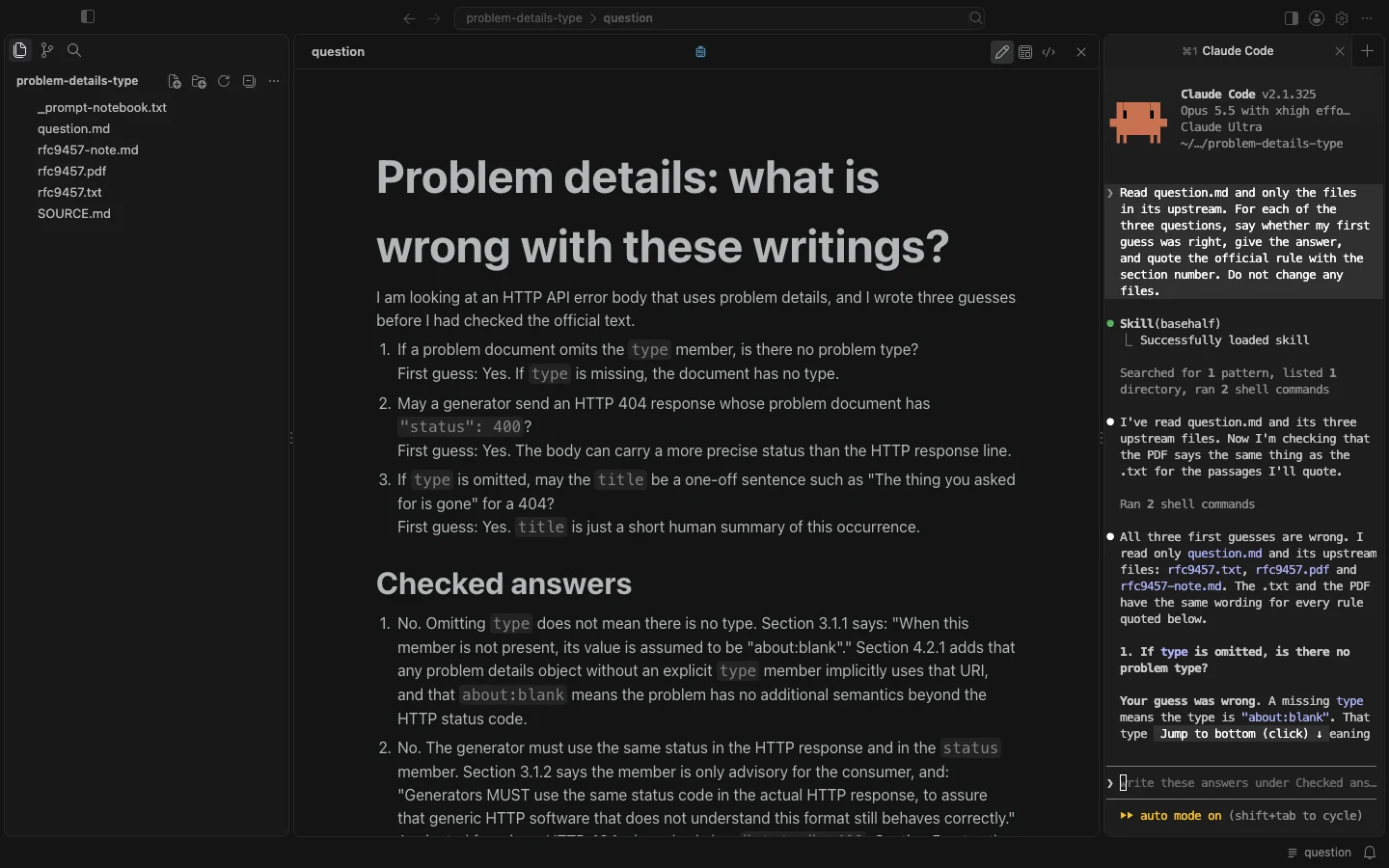
I wrote those checked answers, with the section numbers, the sentences I used, and the rejected forms, back into the same question.md page, under the heading I had left for them, and I left my first guesses above that heading. In Card Detail, the Preview shows the answers and the citations in the page I will reopen tomorrow. The Source view shows the upstream list at the top of the same file: rfc9457.pdf, rfc9457.txt, and rfc9457-note.md.
This is not a notebook that answers every file by itself, and it is not a built-in summary. The selection in the status bar lasts only while the window is open. The official text, the grown note, the question, and the checked answers with their rejected forms are ordinary files in the folder. If I close the chat, I still have the page where the wrong writing sits next to the rule.