
Lay out the evidence for and against before you write the conclusion
Put what supports a decision on one side of a BaseHalf canvas and what counts against it on the other. Connect only the evidence the conclusion actually rests on, and leave a mood that is not evidence outside both columns.
A proposal lands in the channel already wrapped in a feeling. “Drop Thursday standup this month. Everyone hates it.” The temptation is to paste the thread into Claude Code or Codex and ask whether the meeting should go. The model will treat the mood as if it were a reason. The cheaper work is earlier, and it is visual: put what actually supports the change on one side of the board, and what actually counts against it on the other, before you write a conclusion.
This is a different step from unpacking a fog until you can name a question, from lining up options against a checklist, from separating a quote from a leap, from sorting facts, assumptions, and open questions, or from keeping a problem away from the fixes already being offered. Here the question is already named. The risk is that a feeling, or a fact that does not bear on this decision, gets filed as if it were evidence for the answer.
Should we drop Thursday standup this month?
Say a small product team is arguing about this. Around the proposal, people have already collected things they can point to.
On the side for dropping it:
- The scheduled slot is 15 minutes. The last four Thursdays ran 28, 31, 25, and 35 minutes. These are the recorded lengths, not a guess that meetings always overrun.
- Two teammates are in a timezone where 9:30 Thursday is 22:30. Both have been on the call for the last four weeks.
- For those same four Thursdays, every action item spoken on the call was already in the issue tracker before the meeting started. This is from the tracker timestamps, not from memory.
On the side against dropping it:
- Last month, a release was blocked by a missing certificate. The issue was not in the tracker. It came up in the Thursday standup, and the release was stopped the same morning. This happened once.
- One person has said, more than once, that they follow status by hearing it, and that they often skip the written handoff. This is a stated preference, not proof that writing cannot work for everyone.
- The team tried a written daily handoff for three days in August, then stopped. There is no note explaining why it stopped.
And then there is the sentence that started the thread: “Everyone hates standups.” That is how the channel felt after the 35-minute call. It is a mood, not evidence, so it does not belong in either column.
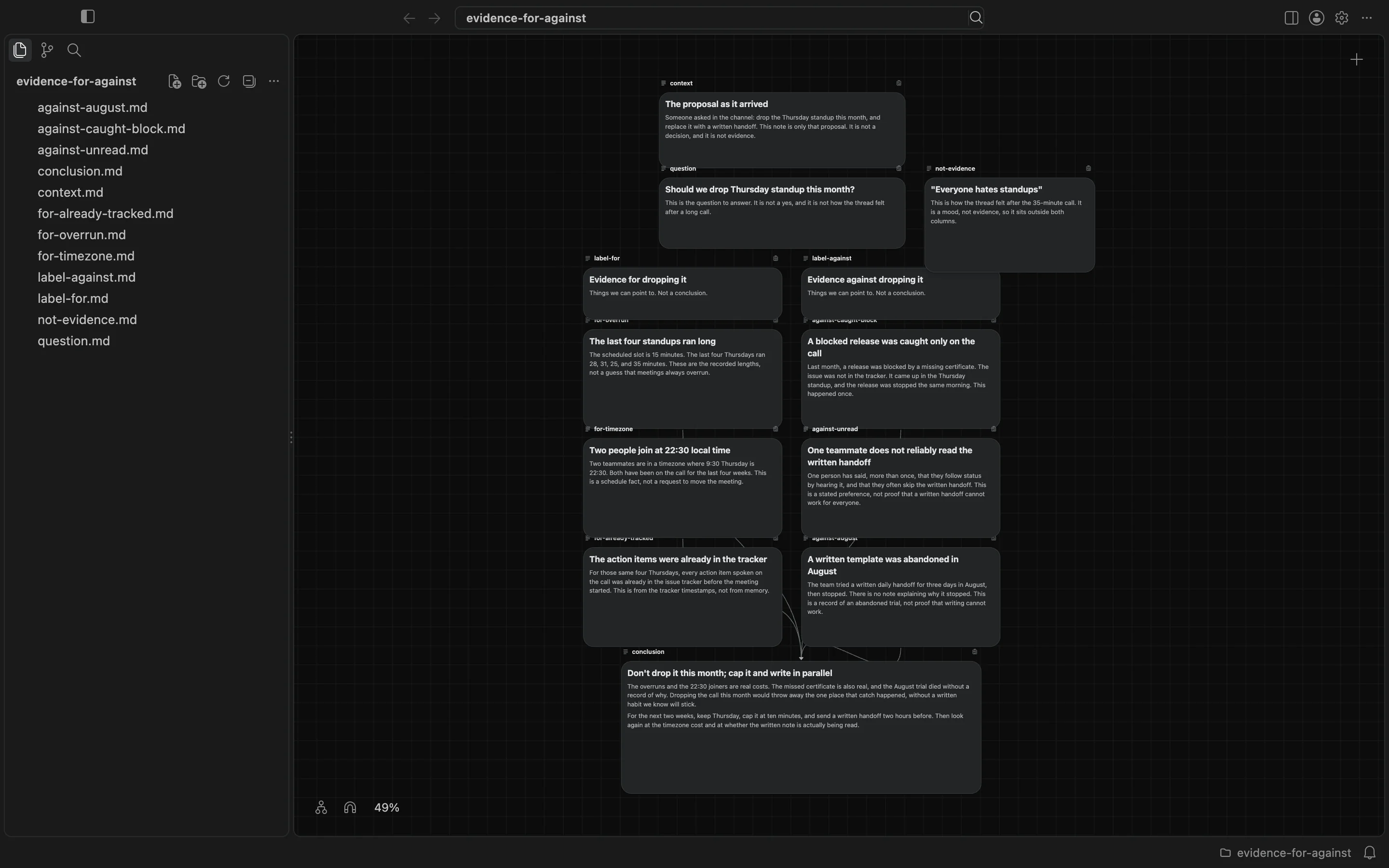
On a BaseHalf canvas, those notes are ordinary Markdown files in one folder. The two columns are for your eyes. The mood card sits off to the side of the question, so it cannot pretend to be a reason.
A column is not a connection, and neither is a selection
Sitting in the “for” column does not make a note part of the conclusion. A connection does. In BaseHalf, a line from A to B means A is upstream of B: A's context flows into B, and the list is saved in B, in the frontmatter of a Markdown note. The conclusion on this board is connected only to the four notes it actually rests on: the overruns, the 22:30 joiners, the missed certificate, and the August trial that died without a record of why.
Two other evidence cards stay in their columns without a line. The tracker timestamps are real, and so is the teammate who prefers to hear status. The conclusion does not use them, so they are not declared as its upstream. The mood card never enters either column.
You can still point at a slice without changing those lists. A selection is temporary. It is what “this” can refer to if you later ask an agent. It is not written into the conclusion, and it does not force an agent to read only those files. A request that names something else still wins.
Select the slice the conclusion already named
For this decision, the slice is the conclusion and the four notes it is connected to. The unconnected evidence and the mood stay visible on the board, and they stay out of the selection.
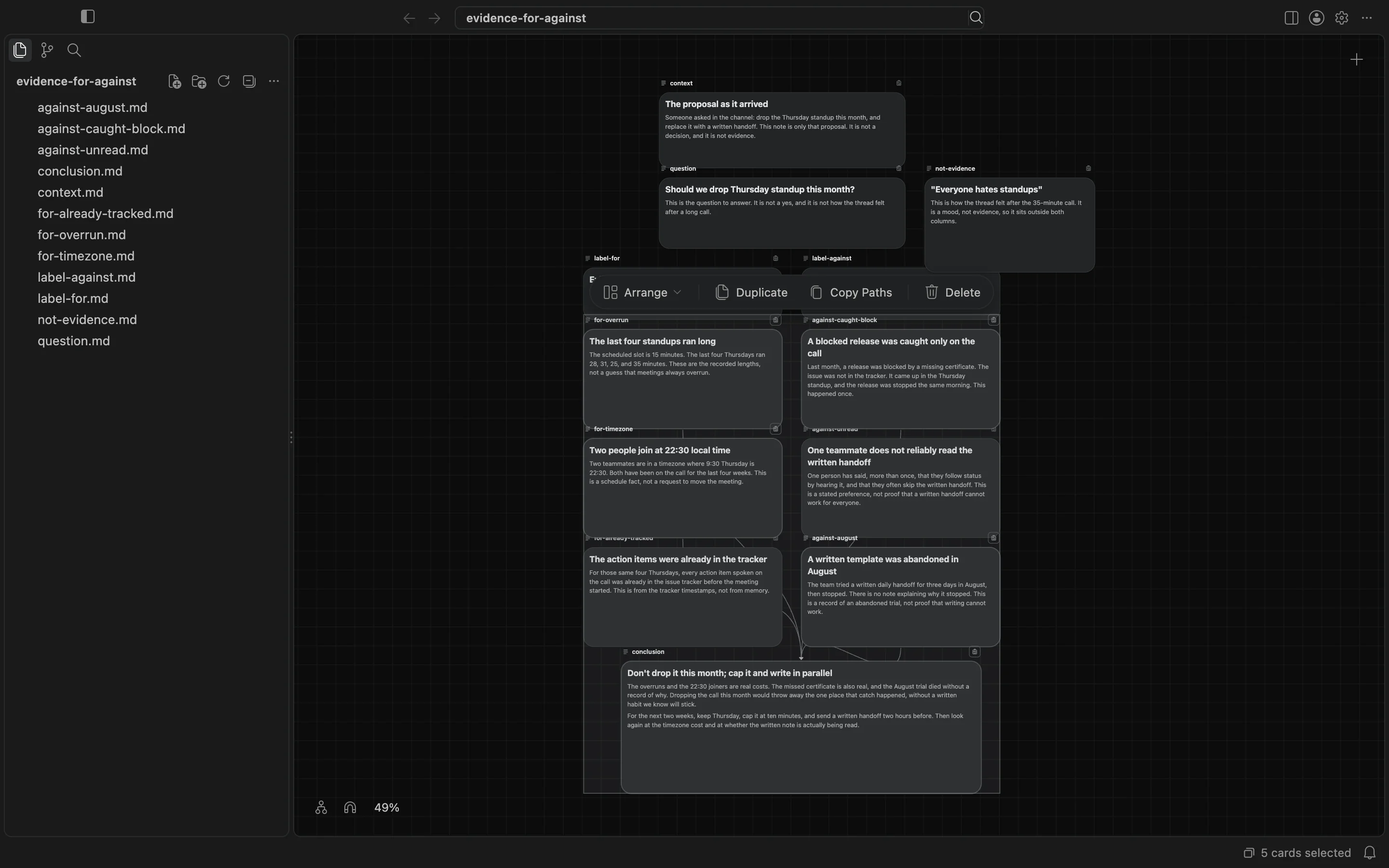
If you then ask Claude Code or Codex, ask about that slice. Not “should we kill standups.” Ask whether those four notes can support the two-week trial the conclusion names: keep Thursday, cap it at ten minutes, and send a written handoff two hours before, then look again at the timezone cost and at whether the written note is actually being read.
What to keep after you decide
Keep the named question, the conclusion, and the upstream list that says which evidence it rests on. Leave the unused evidence in its column for a later look; do not connect it just because it sat nearby. The mood can stay parked, so it is not mistaken for a reason the next time someone opens the folder.
Limits
Two columns do not make the evidence complete, or the conclusion the right one. If the missed certificate was a one-off that already has a checklist, you may have given too much weight to a catch that will not happen again. The canvas makes it visible which notes you chose to stand on. You still have to decide whether those notes are enough.
Put the evidence for and against in two columns before you write the conclusion. Write upstream only for the evidence that conclusion actually uses. Select that slice if you want to ask an agent about it.