
The inner product adds the matching products
In the same BaseHalf folder, I grew a note from the definition of the inner product in §1.4, checked the properties and the general examples, and worked Exercises 1.8 and 1.9.
vmls-note-6.md still pointed at the definition of a linear combination on printed page 17, and 06-linear-combination.md still had the checks from part 6. I stayed in the same Desktop folder in BaseHalf 0.7.0 and kept reading, now from printed page 19.
This is part 7 of the close reading of Boyd and Vandenberghe's Introduction to Applied Linear Algebra. I did not start a new canvas. The inner product is a number, not another vector: you multiply the matching entries and add those products.
A note grown from the definition of the inner product
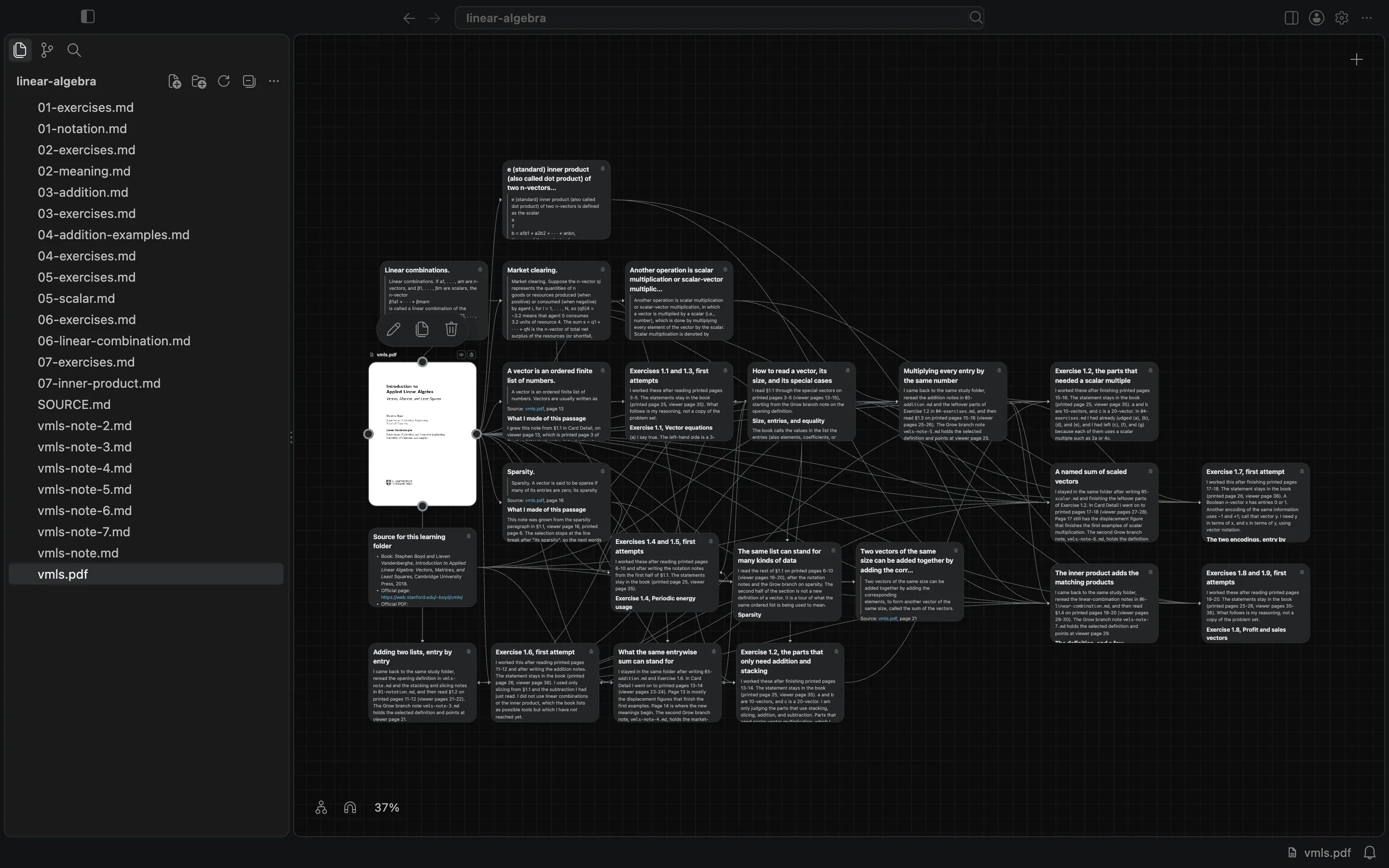
In Card Detail I went to viewer page 29, printed page 19, selected the opening definition of the inner product, and chose Grow branch, again from the reader, not from the cover. The new file was vmls-note-7.md. It already listed vmls.pdf as upstream and pointed at page 29.
The claim I needed was already in what was selected: the inner product of two n-vectors is the scalar
a^T b = a_1 b_1 + a_2 b_2 + ··· + a_n b_n
The selection starts after the first two letters of "The", so the note begins at "e (standard) inner product" rather than "The (standard) inner product". It also stops at a line break, so the last words are "in the notation used in th" rather than the rest of that sentence in the book. I am not treating the cut line as the whole sentence.
The superscript T will be explained in chapter 6; I am treating a^T b as a name for that sum, not as an operation I have already learned. The book lists other names it will not use, such as ⟨a, b⟩ and a · b. I already know that (a, b) in this book means a stacked vector of length 2n, so I will not reuse that writing for an inner product.
I first redid the book's 3-vector example, with the 1-based indexes from earlier notes: if a = (−1, 2, 2) and b = (1, 0, −3), then (−1)(1) + (2)(0) + (2)(−3) = −7. I also checked a list of my own: if a = (3, −1, 4) and b = (2, 5, 0), then 3·2 + (−1)·5 + 4·0 = 1. When the vectors have size 1, the inner product is just the ordinary product of two numbers.
Properties I actually checked, and a few named sums
I wrote the rest into 07-inner-product.md, with the book, the new Grow branch note, and the earlier notes on addition and scalar multiplication as upstream. The book says the laws are easy to figure out from the definition, so I used the same vectors a = (3, −1, 4) and b = (2, 5, 0), together with c = (1, 1, 1) and the scalar 2.
a^T b is 1, and b^T a = 2·3 + 5·(−1) + 0·4 = 1, so the product is commutative. For the scalar law, 2a = (6, −2, 8) and (2a)^T b = 12 − 10 + 0 = 2, which is 2 times 1. For the distributive law, a + b = (5, 4, 4) and (a + b)^T c = 13, while a^T c = 6 and b^T c = 7, which add to 13.
Those combine into a four-term expansion. On printed page 20 the book points out that the plus signs on the left add vectors, while the plus signs on the right add numbers. I checked this with d = (0, 1, −1): the left-hand side is (a + b)^T (c + d) = (5, 4, 4)^T (1, 2, 0) = 13, and the four inner products on the right are 6 + (−5) + 7 + 5 = 13.
The same page also names a few special cases I already had the parts for. The inner product with a standard unit vector picks out one entry. The inner product with the ones vector is the sum of the entries. The inner product with (1/n)1 is the average. The inner product of a vector with itself is the sum of squares of its entries. If b is a 0-1 selector, b^T a keeps only the entries of a whose matching entry in b is 1. I used the sum and the selector again in Exercise 1.9.
If two vectors are built from conforming blocks, their inner product is just the sum of the inner products of those blocks. I stopped before the Applications paragraphs, which start on the same printed page and are the next part.
Exercises 1.8 and 1.9
The attempts are in 07-exercises.md. The statements stay in the book, on printed pages 25-26.
In Exercise 1.8, p is the n-vector of profit per unit and s is the n-vector of units sold. The total profit is the sum of matching products, which is p^T s. Some entries of p can be negative, and some entries of s can be negative; the same sum still makes sense. I checked this on a list of my own, p = (2, −1, 4) and s = (10, 5, −1): p^T s = 20 − 5 − 4 = 11.
In Exercise 1.9, s is a 20-vector of 0s and 1s that records symptoms. The total number of symptoms is 1^T s, using the ones vector of size 20. For the first ten symptoms, the patient exhibiting five of them means 1^T s_{1:10} = 5, with the slice notation already in 01-notation.md. The same claim can be written as a selective sum: if b is 1 in the first ten entries and 0 in the last ten, then b^T s = 5. I checked both writings on a short list of my own, as if there were only ten symptoms, s = (1, 1, 0, 1, 0, 0, 0, 0, 0, 0): both 1^T s_{1:10} and b^T s equal 3.
I checked both exercises against the definition in vmls-note-7.md, the sum and selective-sum examples in 07-inner-product.md, and the slice notation in 01-notation.md, not against a solution key. I did not ask an agent to grade them in this session.
What stays for the next part
vmls-note-7.md, 07-inner-product.md, and 07-exercises.md now sit in the same folder as the linear-combination notes. I have the definition, the properties I checked, and two exercises that use the sum and the selector. The Applications paragraphs on printed pages 20-22 are still next.
This is part 7 of Learning applied linear algebra with BaseHalf, a close reading of Introduction to Applied Linear Algebra. Previous: A linear combination is a sum of scaled vectors.