
Multiplying a vector by a number scales every entry
In the same BaseHalf folder, I grew a note from the opening definition in §1.3, checked the entrywise properties, and finished the leftover parts of Exercise 1.2.
The notes from addition were already in the folder. 04-exercises.md still had three parts of Exercise 1.2 waiting, because each of them used a scalar multiple I had not read yet. I opened the same Desktop folder in BaseHalf 0.7.0 and kept reading, now from printed page 15.
This is part 5 of the close reading of Boyd and Vandenberghe's Introduction to Applied Linear Algebra. I did not start a new canvas. Scalar-vector multiplication is an operation on the same ordered lists, not a new kind of object.
A note grown from the definition
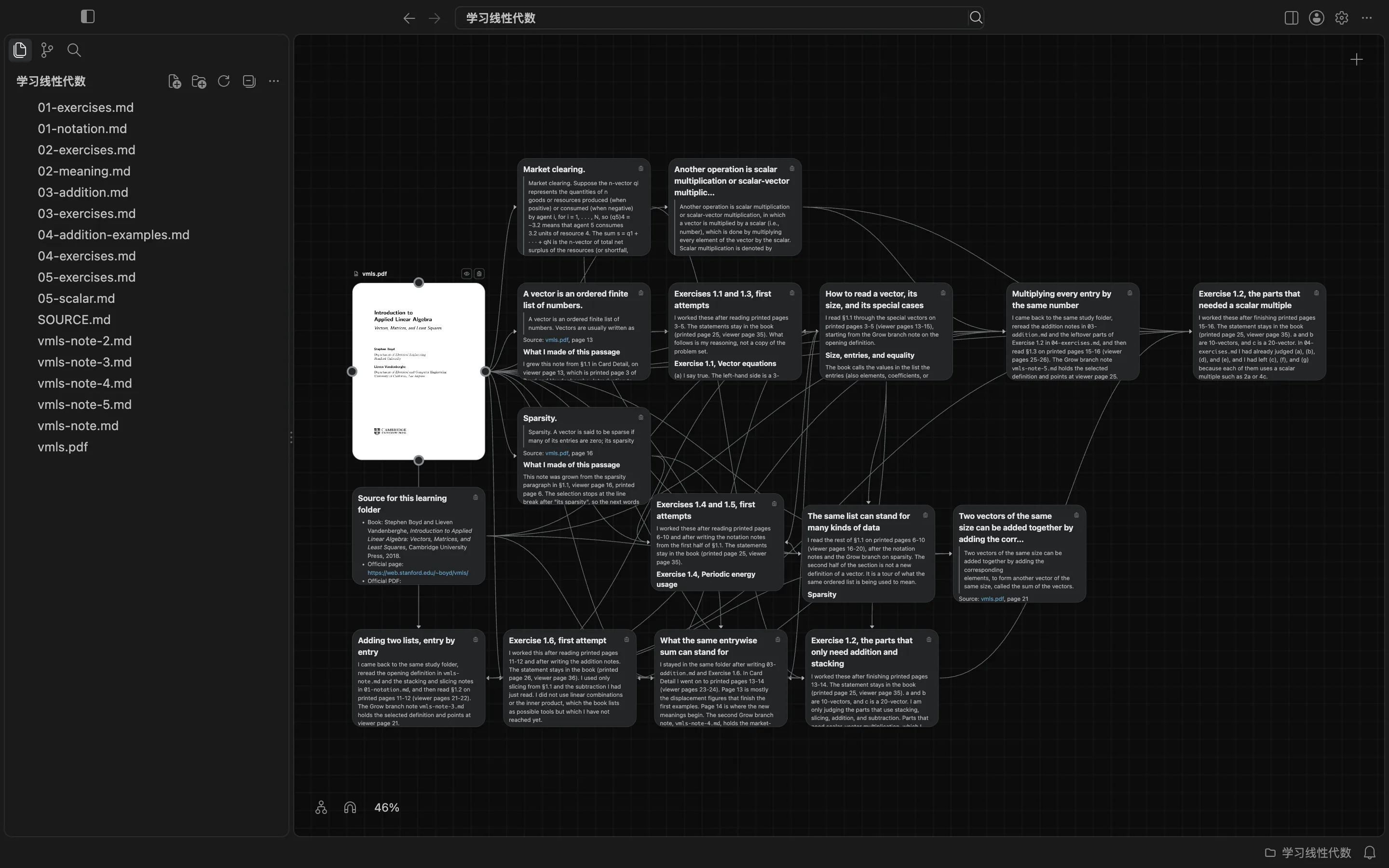
In Card Detail I went to viewer page 25, printed page 15, selected the opening definition of §1.3, and chose Grow branch, from the reader, not from the cover. The new file was vmls-note-5.md. It already listed vmls.pdf as upstream and pointed at page 25.
The selected sentences are complete on the point I needed: a vector is multiplied by a scalar by multiplying every entry by that number, and the result is another vector of the same size. The selection stops at a line break, so the note ends at "Scalar multiplication is denoted by" rather than the rest of that sentence. I am not treating the cut line as the whole sentence.
The book also writes the scalar on the right, as in a(3), with the same meaning. A similar shorthand is a/2, which means (1/2)a. The product (-1)a is written -a. And 0a = 0, where the 0 on the left is the number zero and the 0 on the right is the zero vector of the same size as a, the same overloading I already had in 01-notation.md.
Properties I actually checked
I kept reading through printed page 16 in the same reader, then wrote what I had understood into 05-scalar.md, with the book, the new Grow branch note, and the earlier notation and addition notes as upstream.
The book says these laws are easy to figure out from the definition. I followed that on a 3-vector of my own, a = (1, 4, −2).
3a is (3, 12, −6), and a(3) is the same list, so the product can be written in either order. (2·3)a and 2(3a) are both (6, 24, −12), so βγa is unambiguous. (2 + 3)a is 5a = (5, 20, −10), and 2a + 3a is (2, 8, −4) + (3, 12, −6), the same list. The + on the left adds numbers; the + on the right adds vectors, and scalar multiplication binds more tightly than that addition.
There is also a distributive law over vector addition: β(a + b) = βa + βb, and both plus signs add vectors. With b = (0, 1, 1), a + b is (1, 5, −1) and 2(a + b) is (2, 10, −2). Then 2a + 2b is (2, 8, −4) + (0, 2, 2), again (2, 10, −2).
I am not treating this as a vector space yet. I now have addition and scalar multiplication, and I have not reached linear combinations.
The first examples on printed page 16 are displacements, a bill of materials, and an audio signal. If a is a displacement and β > 0, βa stays in the same direction and its magnitude is scaled by β. If β < 0, the direction reverses and the magnitude is scaled by |β|. A materials list q for one unit, scaled by a nonnegative α, is the list needed for α units. If a is an audio signal, βa is heard as the same signal with its loudness changed by |β|; β = 1/2 and β = −1/2 are both quieter. I stopped this pass before the figure on the next page and before linear combinations, which start on printed page 17.
Exercise 1.2, the leftover parts
The attempt is in 05-exercises.md. I used only the size rule from addition, the stacking from §1.1, and the scalar multiplication I had just read. The statement stays in the book, on printed page 25. a and b are 10-vectors, and c is a 20-vector.
In (c), 2a + c does not make sense. 2a is a 10-vector, the same size as a. c is a 20-vector. Those sizes are different, so they cannot be added.
In (f), [a b] + 4c is not correct either. 4c is a 20-vector, so the left-hand side would have to be a 20-vector as well. But [a b], with a and b written side by side in square brackets, is not a vector notation I have in this book. Stacking is written with parentheses, as in (a, b). In Exercise 1.1(b) I already treated a horizontal square-bracket row as notation the book does not use for a vector.
In (g), the stack of a on top of b, written as a column, plus 4c, does make sense. That stack is (a, b), a 20-vector. 4c is also a 20-vector, so they can be added, and the result is a 20-vector.
I checked those readings against the definition in vmls-note-5.md, the size rule in vmls-note-3.md, the stacking notes in 01-notation.md, and the leftover notes in 04-exercises.md, not against a solution key. I did not ask an agent to grade them in this session.
The folder is still the same work
vmls-note-5.md, 05-scalar.md, and 05-exercises.md now sit in the same folder as the definition of addition and Exercise 1.6. If I open this window again, those notes are still there to be reread. Linear combinations, and a few named special cases of them, are next.
This is part 5 of Learning applied linear algebra with BaseHalf, a close reading of Introduction to Applied Linear Algebra. Previous: The same entrywise sum can be a trade, or a market that clears. Next: A linear combination is a sum of scaled vectors.