
Adding two vectors means adding the matching entries
In the same BaseHalf folder, I grew a note from the opening definition in §1.2, checked the entrywise properties, and used slicing and subtraction to work Exercise 1.6.
The first two notes were already in the folder. vmls-note.md still pointed at the opening definition on printed page 3, and 01-notation.md still had the 1-based index, the stacking rule, and the overloaded 0. I opened the same Desktop folder in BaseHalf 0.6.1 and kept reading, now from printed page 11.
This is part 3 of the close reading of Boyd and Vandenberghe's Introduction to Applied Linear Algebra. I did not start a new canvas, and I did not treat addition as a new kind of object. It is an operation on the same ordered lists.
A note grown from the definition of addition
In Card Detail I went to viewer page 21, printed page 11, selected the opening definition of §1.2, and chose Grow branch, from the reader, not from the cover. The new file was vmls-note-3.md. It already listed vmls.pdf as upstream and pointed at page 21.
The selected sentences are complete this time: two vectors of the same size can be added by adding the corresponding entries, and the result is another vector of that same size, called the sum. The constraint I am keeping is the size. A 3-vector cannot be added to a 4-vector. The same symbol + is used for numbers and for vectors; which one it is depends on what stands on each side, the same kind of overloading I already had for 0.
Subtraction, and four properties I actually checked
I kept reading through printed page 12 in the same reader, then wrote what I had understood into 03-addition.md, with the book, the new Grow branch note, and the earlier notation notes as upstream.
Subtraction is the same idea with a minus sign, and the result is called the difference. I redid the book's first addition with the 1-based index from the earlier notes:
(0, 7, 3) + (1, 2, 0) = (1, 9, 3)
and the subtraction
(1, 9) − (1, 1) = (0, 8)
The book lists four properties for vectors of the same size, and then shows how to derive commutativity from the definition and from ordinary numbers commuting. I followed that argument, and I checked the others on the same 3-vector example.
If a = (0, 7, 3) and b = (1, 2, 0), then b + a is also (1, 9, 3). With c = (1, 0, 1), both (a + b) + c and a + (b + c) are (2, 9, 4), so a + b + c is unambiguous. Adding the zero vector does nothing, and that 0 has to be the zero vector of the same size as a, which is the overloading already in 01-notation.md. Finally, a − a is that same zero: (0, 7, 3) − (0, 7, 3) = (0, 0, 0).
I am not treating this as a vector space yet. I have addition, not scalar multiplication.
The first examples on printed page 12 are displacements. If a and b are displacements, a + b is the net displacement of doing a and then b, and b + a ends at the same place, which is the geometry of the commutativity I had just checked. If p is a position and a is a displacement, p + a is the new position. If p and q are two positions, p − q is the displacement from q to p. Word counts and a bill of materials are the same entrywise sum, now with a meaning. I stopped this pass before the later examples on printed pages 13 and 14.
Exercise 1.6
The attempt is in 03-exercises.md. I used only slicing from the first half of §1.1 and the subtraction I had just read. The statement stays in the book, on printed page 26.
x is an n-vector. The associated vector of differences is the (n − 1)-vector d of consecutive changes, written in the notes as d = (x_2 − x_1, …, x_n − x_{n-1}). The slice x_{2:n} is (x_2, …, x_n), and x_{1:n-1} is (x_1, …, x_{n-1}). Both have length n − 1, so they can be subtracted, and that difference is exactly d:
d = x_{2:n} − x_{1:n-1}
I checked this on a short list of my own, x = (3, 1, 4, 2). Then d should be (−2, 3, −2). The slices are (1, 4, 2) and (3, 1, 4), and (1, 4, 2) − (3, 1, 4) = (−2, 3, −2). When x is a time series, d is the period-to-period change. I did not use linear combinations or the inner product, which I have not reached yet.
I checked the formula against the definition of subtraction and the slicing rule in 01-notation.md, not against a solution key. I did not ask an agent to grade the work in this session.
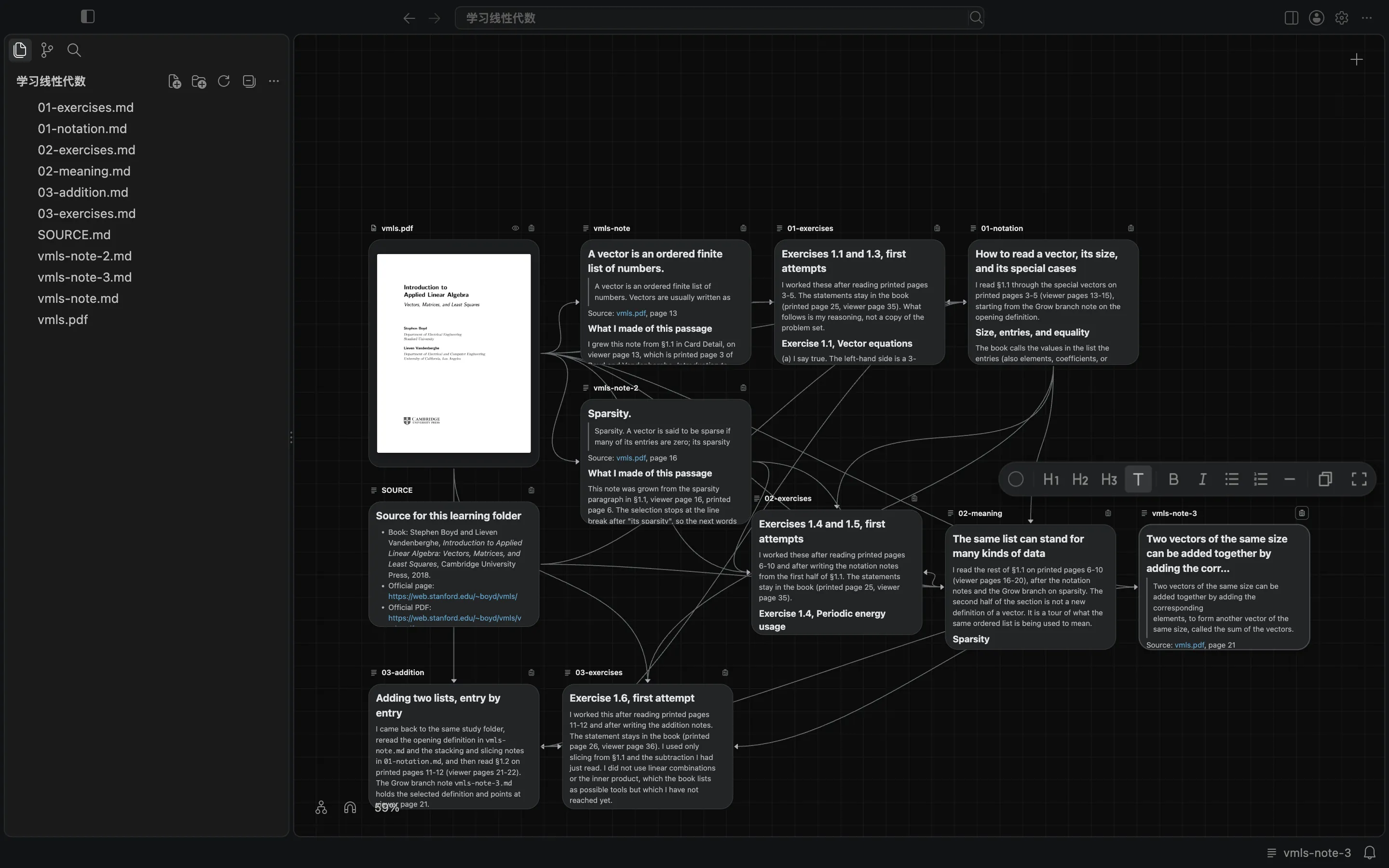
The folder is still the same work
vmls-note-3.md, 03-addition.md, and 03-exercises.md now sit in the same folder as the first definition and the examples from §1.1. If I open this window again, those notes are still there to be reread. The later meanings of the sum, and a warning about what + does not mean, are next.
This is part 3 of Learning applied linear algebra with BaseHalf, a close reading of Introduction to Applied Linear Algebra. Previous: The same kind of list can be a color, a portfolio, or a week of use. Next: The same entrywise sum can be a trade, or a market that clears.