
The same kind of list can be a color, a portfolio, or a week of use
In the same BaseHalf folder, I kept reading §1.1, grew a note from the sparsity paragraph, and used stacking, slicing, and those examples to work Exercises 1.4 and 1.5.
The first half of §1.1 was already in the folder. vmls-note.md still pointed at the opening definition on printed page 3, and 01-notation.md still had the stacking rule, the 1-based index, and the overloaded 0. I opened the same Desktop folder in BaseHalf 0.6.0, and kept reading from printed page 6.
This is part 2 of the close reading of Boyd and Vandenberghe's Introduction to Applied Linear Algebra. I did not start a new canvas, and I did not treat the rest of the section as a new definition of a vector.
A second note, grown from sparsity
In Card Detail I went to viewer page 16, printed page 6, selected the sparsity paragraph, and chose Grow branch again, from the reader, not from the cover. The new file was vmls-note-2.md. It already listed vmls.pdf as upstream and pointed at page 16.
The selected lines stop at a line break, so they end with "its sparsity" rather than the next words in the book. I wrote that cut into the note, and I did not pretend the fragment was the whole sentence. The claim I needed was already there: a vector is sparse when many of its entries are zero. The sparsity pattern is the set of indices that are not zero. A unit vector, which I already had from the first half, has only one nonzero entry. The zero vector has none.
The list stays the same; the story of the entries changes
I wrote the tour of examples into 02-meaning.md, with the book, the new Grow branch note, and the earlier notation notes as upstream. A 2-vector or 3-vector can be a location, or a displacement drawn as an arrow. A 3-vector can be an RGB color, with (0, 0, 0) as black. The same kind of n-vector can be quantities of n resources, a portfolio of n assets, a measurement across n people, or fractions that are nonnegative and add to one.
A time series puts samples in time order. A cash flow uses positive entries for money coming in and negative entries for money going out. An image is a long list of pixel intensities in a fixed order. A word-count vector tallies a dictionary. A customer's purchases, or a 0-1 record of which events occurred, are often sparse. A feature vector can put unlike measurements, with different units, into one list for a single object.
The point I am carrying forward is not a gallery of applications. It is that swapping two entries still changes the meaning, whether those entries are coordinates, days, or products. That is why the first definition insisted on order.
Exercises 1.4 and 1.5
The attempts are in 02-exercises.md. I used only stacking and slicing from the first half, plus the examples I had just read. The statements stay in the book, on printed page 25.
For 1.4, w is a 168-vector of hourly electricity use over one week, and it repeats every 24 hours. d is the 24-vector for one day starting at midnight. I wrote
w = (d, d, d, d, d, d, d)
and
d = w_{1:24}
Seven copies of a 24-vector give size 168, which matches. Because the week is 24-periodic, later slices such as w_{25:48} are the same vector, but w_{1:24} is the day the week itself starts on.
For 1.5, a sparse x means many entries are zero. In a daily cash flow, only a few days have a payment. In a customer's annual purchases, only a few products were bought. In a portfolio, only a few stocks are held. In a bill of materials, only a few listed materials are used. In a monochrome image, most pixels have brightness 0; in this book, 0 is black, so the picture is mostly black, with only a few lit pixels. In a year of daily rainfall, rain falls on only a few days.
I checked those readings against the sparsity paragraph and the examples on printed pages 6 to 10, not against a solution key. I did not ask an agent to grade them in this session.
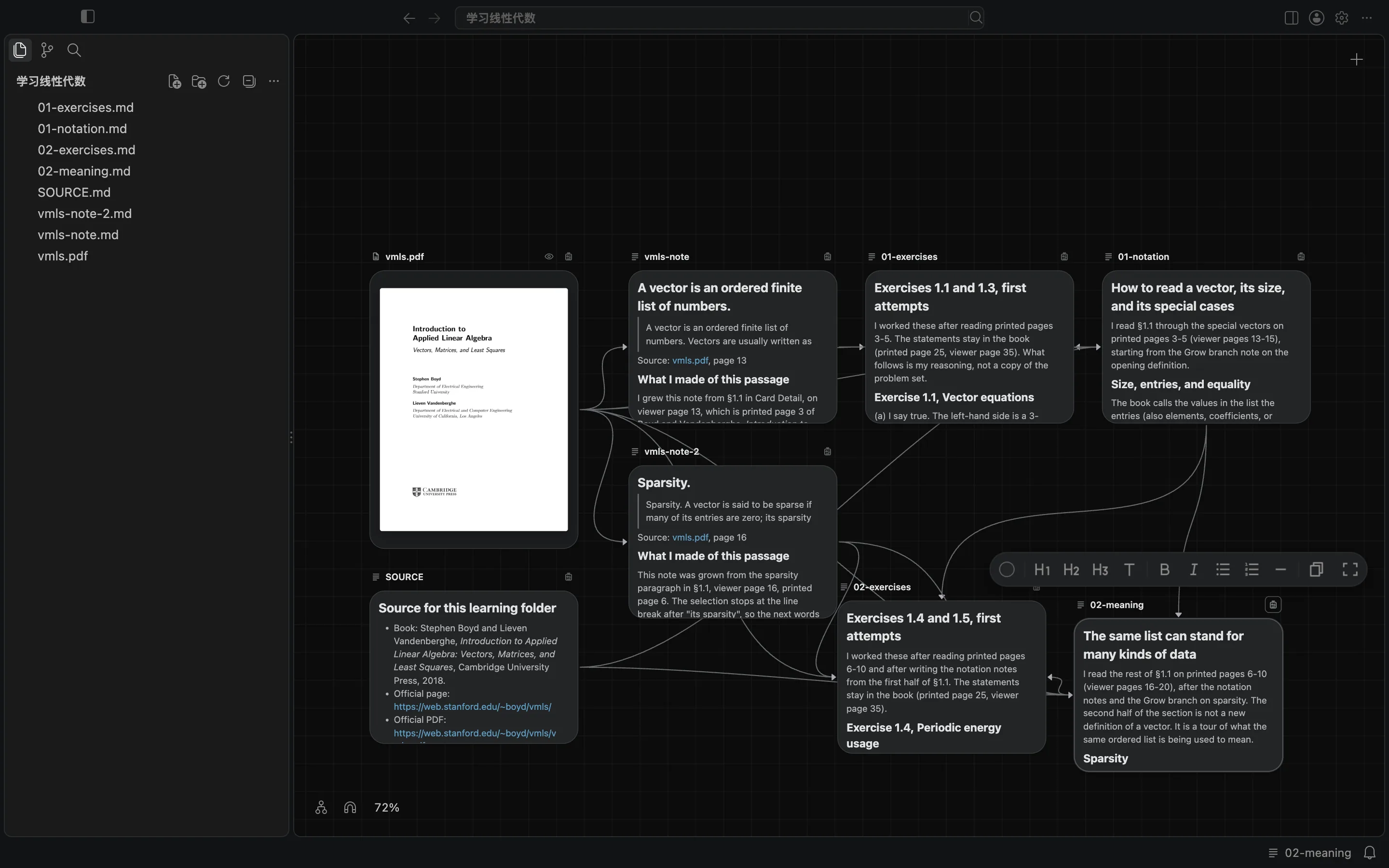
The folder is the continuing work
02-meaning.md and 02-exercises.md now sit in the same folder as the first definition, the first exercises, and the source record. If I open this window again, the old notes are still there to be reread, and §1.1 is finished only in the sense that I have read the section and tried the four representative exercises. Addition is still next.
This is part 2 of Learning applied linear algebra with BaseHalf, a close reading of Introduction to Applied Linear Algebra. Previous: A vector is an ordered list, and its length counts.