
A vector is an ordered list, and its length counts
I opened Boyd and Vandenberghe's applied linear algebra book in BaseHalf, grew a note from the first definition in §1.1, and worked Exercises 1.1 and 1.3 from the notation on printed pages 3 to 5.
I wanted a way to stay with one book instead of starting a fresh demo each evening. The book is Stephen Boyd and Lieven Vandenberghe's Introduction to Applied Linear Algebra, published by Cambridge University Press in 2018. The authors host a complete PDF on the official page, with the publisher's agreement. I keep a local copy in a single Desktop folder for this book, under basehalf-learn-sessions, and I opened that folder in BaseHalf 0.6.0. The window title is the folder name. The PDF became an ordinary card.
This is the first post in a close reading of that one book. I am not swapping in another course, and I am not treating a free official download as a licence to republish the book.
A note grown from the first definition
I opened vmls.pdf in Card Detail, which is the PDF reader, and went to viewer page 13, printed page 3, where §1.1 begins. I selected the opening definition and chose Grow branch. That action lives in the reader, after a passage is selected. It is not something I can start from the small cover on the canvas, and it is not the same as dragging a connection on the canvas.
The new file was vmls-note.md. It already listed vmls.pdf as upstream, quoted the selected lines, and pointed back to the source on page 13. On the canvas, a line ran from the book into the note.
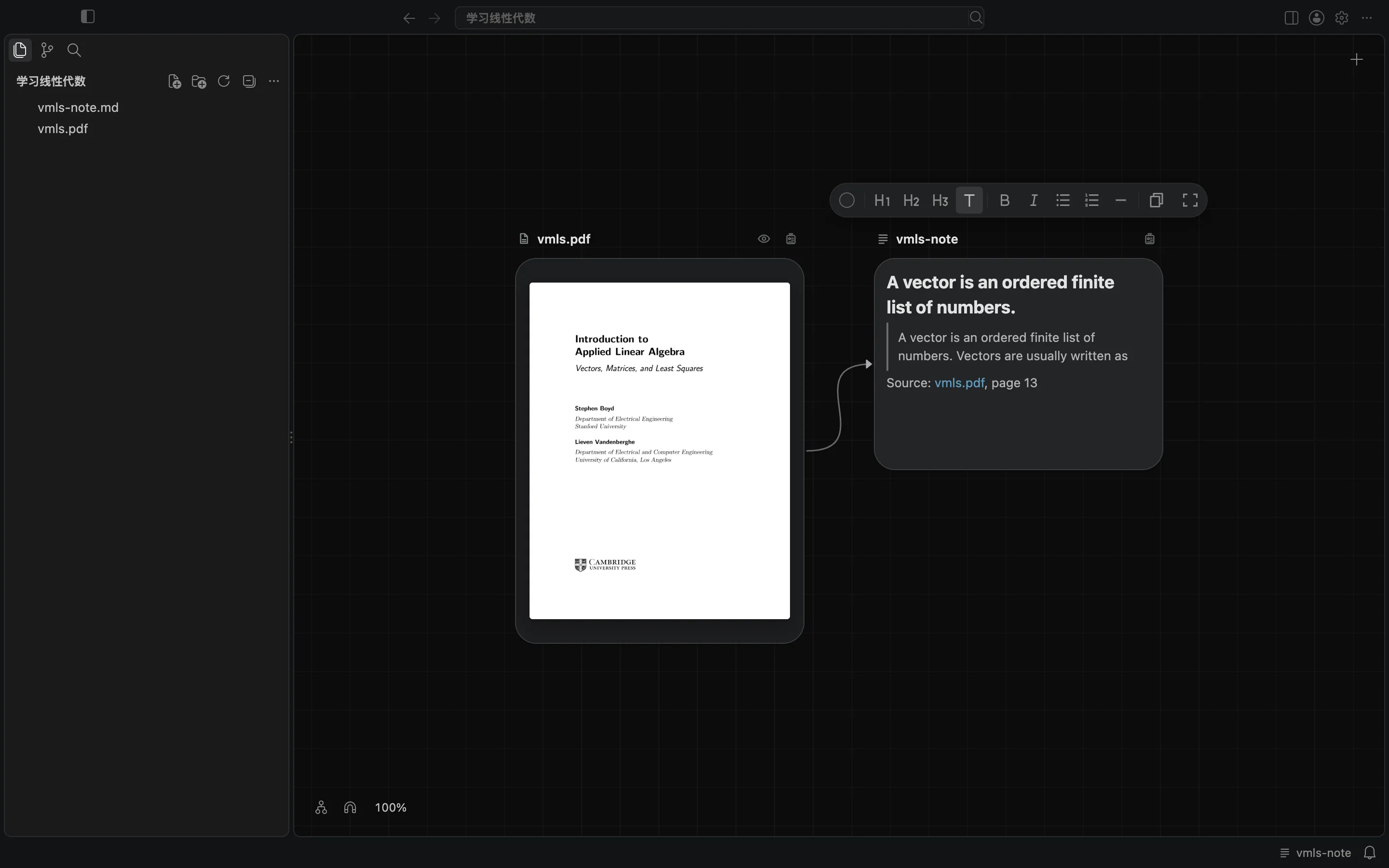
The definition I kept is short: a vector is an ordered finite list of numbers. Order is part of the data. If two entries swap places, it is not the same vector. The length of the list is the size, also called the dimension. An n-vector has n entries, and a 1-vector is treated as the same thing as the number itself.
Two vectors are equal only when they have the same size and each corresponding entry is equal. The book writes the entries with a subscript that runs from 1 to n, not from 0. I will keep that 1-based index when I write math from this book.
Stacking, slices, and a symbol that changes meaning
I kept reading through printed pages 4 and 5 in the same reader, then wrote what I had understood into 01-notation.md, with the book and the Grow branch note as upstream.
A stacked vector is concatenation. If a is a 3-vector, (1, a) is the 4-vector (1, a_1, a_2, a_3), not a pair. A slice a_{r:s} is (a_r, ..., a_s). The book's own check is easy to redo: for z = (1, -1, 2, 0), the slice z_{2:3} is (-1, 2).
The same subscript can mean two different things. a_3 might be the third entry of a vector a, or the third vector in a list. When a list of vectors is in play, (a_i)_j is the jth entry of the ith vector.
The zero vector has every entry 0, and the same symbol 0 is used for every size. The size comes from the equation it appears in. The ith unit vector e_i has a 1 in position i and 0 elsewhere. The ones vector is 1_n, or 1 when the size is already clear. I am not treating any of this as a linear space yet. Addition and scalar multiplication are still ahead.
Exercises 1.1 and 1.3
I wrote the attempts in 01-exercises.md. The problem statements stay in the book, on printed page 25. What I am publishing is my reasoning.
In 1.1, I called (a) true: a vertical 3-vector and the comma-and-parentheses form (1, 2, 1) are the same writing of one vector. I called (b) bad notation, because the book does not introduce a horizontal square-bracket row as a way to write a 3-vector. I called (c) true: (1, (2, 1)) and ((1, 2), 1) both stack to (1, 2, 1).
In 1.3, a is a 10-vector and b is a 20-vector. I read (0, a) the way the book reads (1, a): the leading 0 is the number 0, so (0, a) has size 11 and cannot equal b. (0, b) is worse. For b = (0, a, 0), the reading with numbers has size 12; the reading that overloads both zeros as zero vectors of unspecified size is ambiguous, because many size pairs would add to 10. For a = 0 = b, each half can be read on its own, but the chain would imply a = b across two sizes, so I called it bad notation.
I checked those answers against the stacking example and the overloading paragraph in §1.1, not against a solution key. I did not use addition from later sections, and I did not ask an agent to grade the work in this session.
What stays in the folder
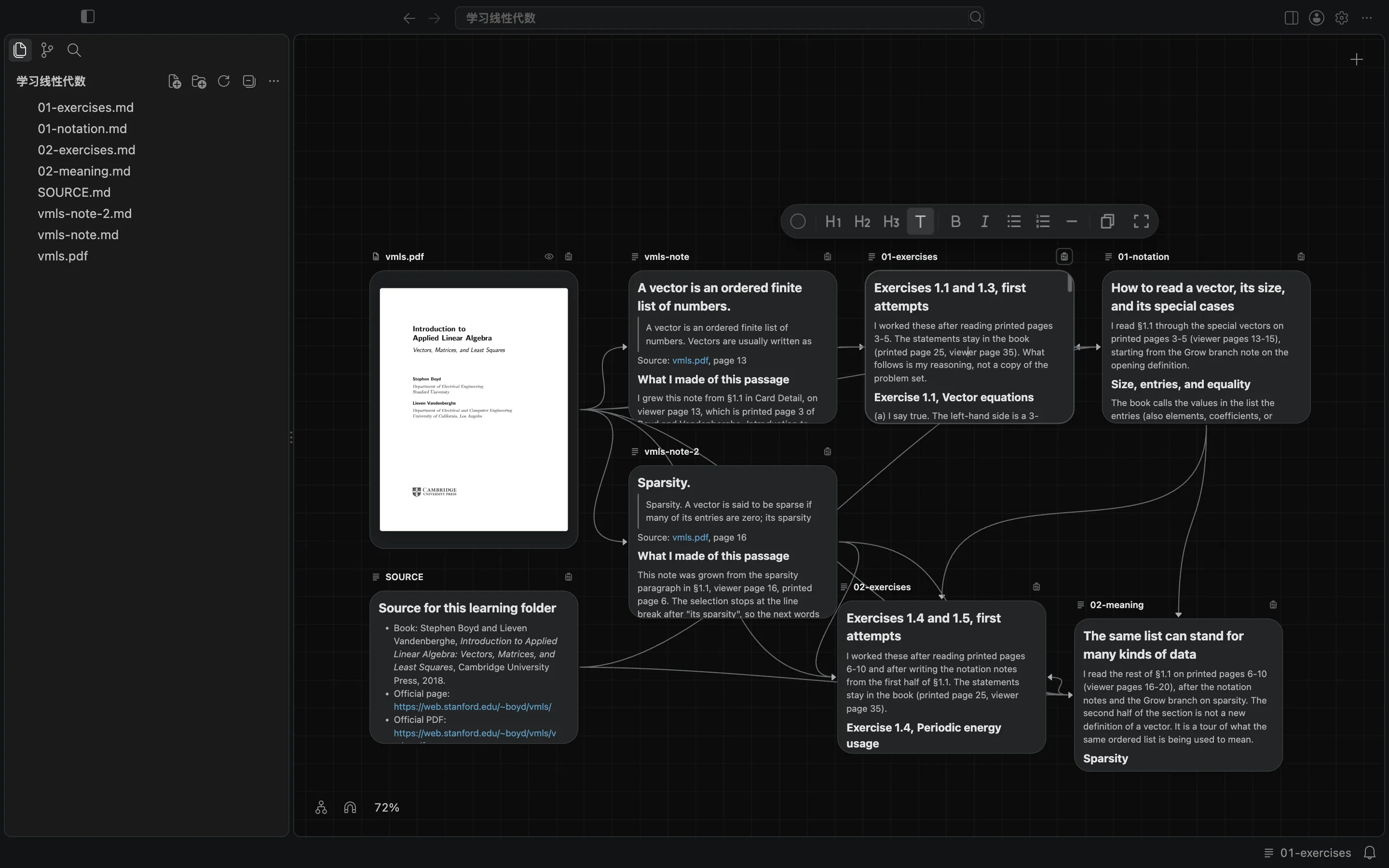
The book, the source record, the Grow branch note, and the two notes I wrote are ordinary files in that same Desktop folder under basehalf-learn-sessions. The connections that matter are in the files, in upstream. The layout of the cards sits beside them. I will come back to this same folder tomorrow, rather than building a new canvas from scratch.
This is part 1 of Learning applied linear algebra with BaseHalf, a close reading of Introduction to Applied Linear Algebra. Next: The same kind of list can be a color, a portfolio, or a week of use.