AI chat vs AI workspace
Why some AI work belongs in a conversation, and some needs a visible workspace.
By BaseHalf
The first generation of AI products taught everyone to start with a prompt.
That was the right starting point. A prompt box makes AI feel immediate. You can ask a question without designing a system around it.
But as AI becomes part of real work, the prompt box starts to show its limits. The more valuable the work becomes, the more it needs structure around the answer.
That is the difference between AI chat and an AI workspace.
Chat optimizes for response
AI chat is built around a simple loop:
- You ask.
- The assistant responds.
- You clarify.
- The assistant responds again.
This loop is excellent for speed. It is conversational, forgiving, and low-friction.
It is also linear. The thread has an order, but not much visible structure. When the work contains sources, decisions, alternatives, drafts, and follow-ups, the thread can hold them, but it does not naturally separate them.
Workspaces optimize for continuity
An AI workspace starts from a different assumption: the output is not the end of the work.
The answer may become a source for another answer. A decision may constrain a future plan. A draft may need to stay connected to evidence. A study note may need to become a practice question next week.
In that kind of work, continuity matters more than one response.
BaseHalf uses Maps, Points, Blocks, and References to keep that continuity visible.
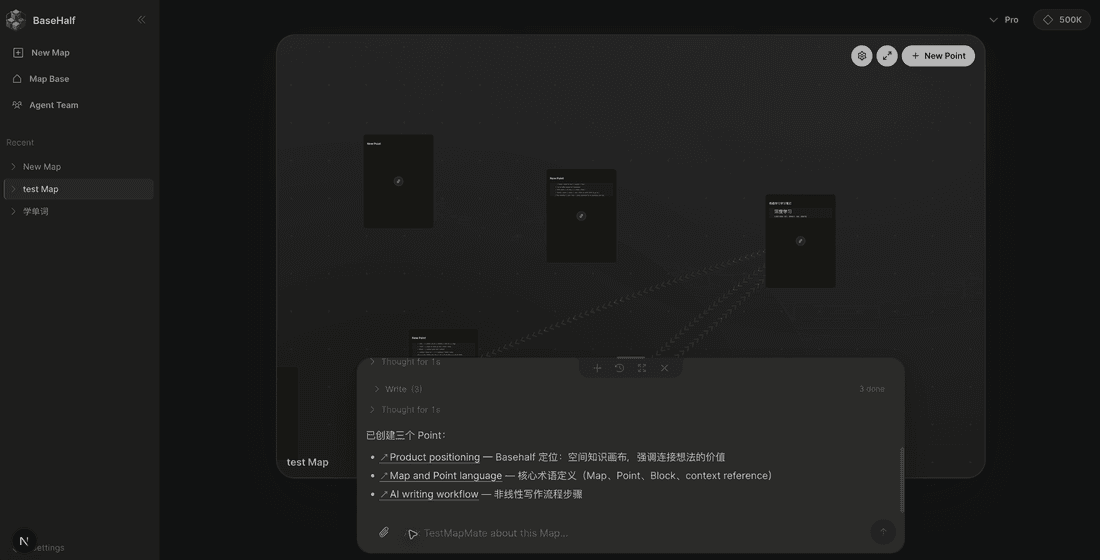
A concrete workflow: from interview notes to a decision
Imagine a product team with five interview transcripts, a draft brief, and one open decision about onboarding. In chat, the team can summarize each transcript, but the summaries, evidence, decision, and follow-up work still share one linear history.
In a visual AI workspace, the team can instead:
- Keep each interview as its own source Point.
- Extract reusable claims without replacing the source notes.
- Connect each claim to the interviews that support or contradict it.
- Open a decision Point with alternatives, evidence, risks, and revisit conditions.
- Draft the brief from the selected claims and decision instead of pasting the project history into another prompt.
This is the practical difference between storing a conversation and preserving a working system. The workspace makes the context inspectable before it asks AI to use it.
The hidden cost of long threads
Long threads feel convenient because everything is technically in one place.
But “in one place” is not the same as organized.
When a thread gets long, you often need to ask questions like:
- Which answer was the final one?
- Which source supported this claim?
- Which decision changed the plan?
- Which open question is still unresolved?
- Which paragraph should be reused later?
If you have to reconstruct the structure every time, the thread is storing content but not preserving work.
A workspace makes context addressable
The important shift is addressability.
In a workspace, you can point to a specific object:
- this source Point
- this decision Point
- this draft Block
- this unresolved question
- this Reference between two pieces of work
Once context is addressable, it can be reused without being pasted again. It can be reviewed without rereading the whole thread. It can be combined with other context deliberately.
That is what makes AI work compound.
Why this matters for teams
Teams do not only need answers. They need shared state.
If the only record of the work is a private chat thread, other people cannot easily see:
- what was decided
- what evidence mattered
- what changed
- what still needs review
- what context should be reused next time
A workspace makes those pieces visible. It lets AI output become part of the team's working memory instead of staying trapped in one person's conversation.
The future is not chat or workspace
Chat will not disappear. It is too useful.
The better pattern is layered:
- Chat for exploration.
- Workspace for continuity.
- Documents for polished output.
- Files and systems for storage and execution.
BaseHalf focuses on the middle layer: the place where useful AI work becomes visible, editable, connected, and reusable.
If your work has reached that threshold, start with the BaseHalf product model, then follow the move from chat to Map workflow.