BaseHalf vs ChatGPT
ChatGPT is a powerful general AI assistant. BaseHalf is a workspace for keeping AI work visible, editable, and reusable.
By BaseHalf
“BaseHalf vs ChatGPT” is not really a model comparison.
ChatGPT is a general AI assistant. It is excellent for conversation, drafting, analysis, summarization, code help, and quick exploration. It is where many AI workflows naturally begin.
BaseHalf is different. It is not trying to be a better chat box. It is a workspace for the parts of AI work that should remain useful after the first answer.
| Question | ChatGPT | BaseHalf |
|---|---|---|
| Best starting point | A fast conversation | A project with connected parts |
| Primary structure | Messages and threads | Maps, Points, Blocks, and References |
| Reusing context | Continue or summarize a conversation | Select and connect durable project context |
| Reviewing work | Read or search the thread | Inspect sources, decisions, drafts, and open questions separately |
| Strongest fit | One-off exploration and generation | Research, strategy, learning, and complex project work |
The tools can be used together. A conversation can start the work; BaseHalf gives the parts worth keeping a durable structure.
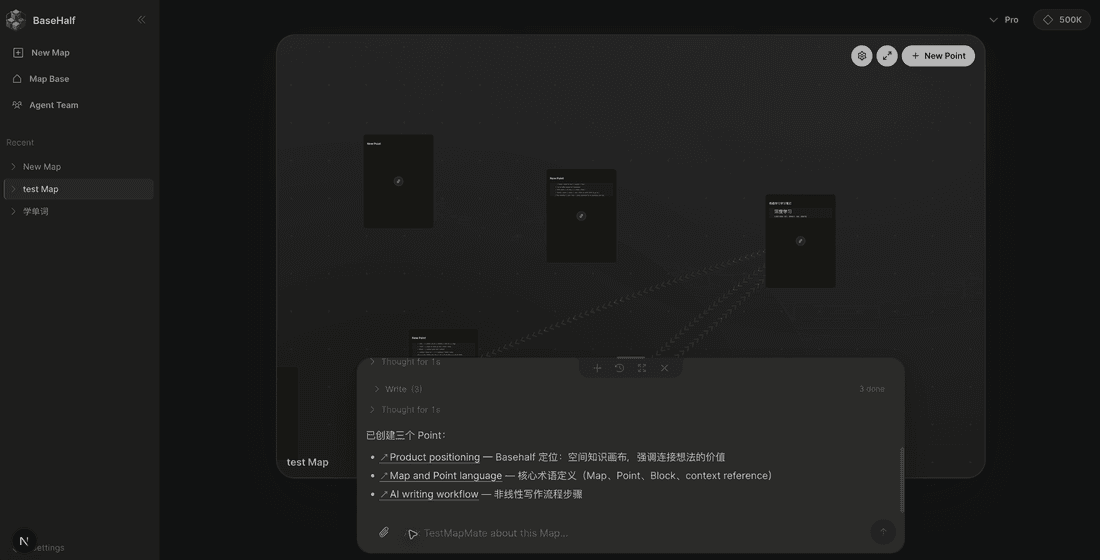
The distinction matters because many AI problems are not caused by weak answers. They are caused by useful answers having nowhere durable to go.
Chat is a strong starting interface
Chat works because it is direct. You ask. The assistant responds. You clarify. It responds again.
That rhythm is powerful for early thinking:
- exploring a question
- rewriting a paragraph
- summarizing a file
- generating alternatives
- testing a plan
- getting unstuck
For many one-off tasks, that is enough. If the answer is useful only once, a thread is a perfectly reasonable place for it.
Threads become fragile when work compounds
The problem appears when the work needs to continue.
A serious thread often contains several kinds of material at once:
- source notes
- assumptions
- decisions
- drafts
- open questions
- examples
- objections
- next steps
As the thread grows, those pieces become harder to reuse. You can scroll, search, paste, or summarize the thread again, but the structure is still implicit. The conversation remembers the order of messages better than it remembers the shape of the work.
That is the gap BaseHalf is designed for.
BaseHalf turns chat output into objects
BaseHalf gives AI work a small object model:
- A Map shows the overall workspace.
- A Point holds one idea, file, question, decision, or task.
- A Block keeps material editable inside a Point.
- A Reference connects Points so context can travel.
This changes the job of AI from “continue the thread” to “work on this part with the right context.”
The answer no longer has to live as one more message in a long exchange. The useful parts can become durable material.
The difference is context reuse
In a chat thread, reusable context often has to be repeated. You paste the same background into the next prompt, summarize earlier decisions, or ask the assistant to infer what still matters.
In BaseHalf, reusable context can be applied again without becoming a wall of copied text. A source Point can inform a draft Point. A decision Point can constrain a plan. A comparison Point can guide a recommendation.
The context stays modular. The output changes because the combination changes.
When ChatGPT is enough
Use ChatGPT or another general AI chat when:
- the task is quick
- the answer is disposable
- the context is short
- the output does not need to be revisited
- the next question does not depend on the previous answer
There is no need to turn every question into a workspace.
When BaseHalf helps
Use BaseHalf when:
- the answer creates follow-up work
- sources and claims need to stay connected
- decisions should shape later outputs
- drafts need to be revised over time
- learning material should become practice
- a team needs to see what context exists
The goal is not more structure for its own sake. The goal is to preserve the useful pieces so they can compound.
A better framing
The useful question is not “Which tool wins?”
The useful question is:
Does this AI work need to survive the conversation?
If not, chat is enough.
If yes, the work needs a surface, objects, and reusable context. That is where BaseHalf begins.
See how to choose an AI workspace or use the research planning workflow for a concrete example.